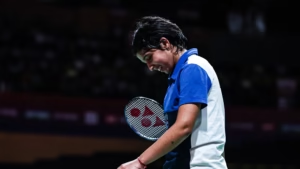
When 2025 began, Sumit Nagal was standing where every Indian tennis fan hoped he would stay inside the ATP Top 100, ranked World No. 96, ready to transition fully to life on the ATP Tour.
But by mid-year, his name had plummeted to World No. 306, his health had faltered, and his confidence wavered. What followed, however, was a remarkable story of resilience. Through autumn clay-court runs and Davis Cup heroics, Nagal clawed his way back to end the year at World No. 280 a far cry from where he started, but a far greater climb than where he could have fallen.
Nagal began 2025 under the bright lights of Australia with one goal to consolidate his Top 100 status. The season started at the Canberra Challenger, where a first-round loss to Patrick Kypson in three sets (6-2, 4-6, 6-1) foreshadowed an uphill year. He managed qualifying wins in Auckland, defeating Adrian Mannarino and Alexander Klintcharov before bowing out to American teenager Alex Michelsen in a tight three-set battle.

But the most damaging blow came at the Australian Open, where illness shadowed his preparation and performance. Facing 26th seed Tomas Machac, Nagal fell 6-3, 6-1, 7-5, failing to defend his 2024 second-round points. By the end of January, he had slipped out of the Top 100. The drop was more psychological than numerical momentum lost, pressure mounting, and no breathing space before a taxing clay swing.
The Strategic Misstep: Skipping India for South America
February brought what might have been the season’s turning point and not for the better. Instead of playing the lucrative Indian Challenger circuit (Chennai, Pune, Delhi, Bengaluru), Nagal opted for the South American Golden Swing, hoping to find rhythm on clay, his preferred surface. It proved to be a strategic error. Battling illness and inconsistency, he managed just two wins across Rosario and Buenos Aires, before retiring in Rio due to fever.
By late February, his ranking had dropped to World No. 129, while the same domestic tournaments he skipped were handing out easy points to mid-ranked competitors. Players like Kyrian Jacquet and Dalibor Svrcina took full advantage winning titles and climbing where Nagal should have been defending.

It was a decision made for long-term gain but delivered immediate damage. The domestic bypass meant lost opportunities and dwindling match confidence.
The Health Crisis and Clay Collapse: March to May
March began with hope but soon unraveled. After a brief rest, Nagal returned to Europe, playing Murcia, Naples, and Marrakech. But his fitness was fragile. In Monza, he retired mid-match against Filip Misolic due to a back injury. What was supposed to be a minor setback became a months-long disruption. His French Open qualifying campaign highlighted the consequences. Although he beat Mitchell Krueger in straight sets in Q1, he fell in Q2 to Jurij Rodionov, 2-6, 4-6. The loss was more revealing than disappointing: a first-serve return rate of just 33%, six breaks conceded, and visibly diminished mobility. The missed Roland Garros main draw the first in two years symbolized how far he had fallen physically and competitively.
By the end of May, Nagal had dropped outside the Top 150. A title defense loss in Heilbronn sent him spiraling further. The summer would test not just his tennis, but his mental endurance. When Nagal reappeared in June, it was with a quieter, more pragmatic approach. Gone were ATP dreams; in their place, a grind for points on the European Challenger Tour. He found rhythm, if not yet reward. He reached the Round of 16 in Poznan and Heilbronn and put up strong fights against names like Garin. His body was holding up, but his conversions weren’t.

Then came a breakthrough of sorts at the Trieste Challenger. After surviving a deciding-set comeback against Chun-Hsin Tseng from 0-4 down, Nagal powered through to the semi-finals, defeating Cecchinato and Mrva before losing to eventual champion Dodig. It was his first deep run in months and a reminder that form can be rebuilt through persistence.
Still, heartbreak wasn’t far away. Across Hagen, Tampere, Bonn, and Sofia, he lost four matches from winning positions, including a 4-1 double-break lead over Andrej Nedic. These collapses hurt deeply both in the rankings and in confidence. By August, he was down to World No. 306, his lowest since May 2023.
The Turning Point: September and October Revival
The final stretch of the season became a story of quiet redemption. Nagal regrouped mentally after a two-week reset in Dubai, working on endurance and focus. The results came quickly. In Tulln, he reached the quarterfinals, defeating Wimbledon junior champion Mili Polijcak and Cristian Jianu before a tight three-set loss to Austria’s Joel Schwaerzler. Then came a career-restoring Davis Cup performance. Facing Switzerland in Biel, Sumit Nagal defeated Marc-Andrea Huesler 6-3, 7(7)-6(4) & reigning junior Australian Open champion Bernet 6-1 6-3 to secure India’s qualification for the 2026 World Group a morale-boosting victory that reconnected him with his best self.
Charlottesville Challenger 2025: Dhakshineswar Suresh Targets Breakthrough Win Over Mitchell Krueger
His late-season form on the Challenger clay circuit was his most consistent stretch all year. In Braga, he reached another QF, pushing Luka Mikrut to a final-set tiebreak, saving five match points before narrowly losing 7-5, 1-6, 6-7(8). In Valencia, he notched wins over Daniel Merida and Pablo Llamas Ruiz before falling to Henri Squire in a close quarterfinal. Across these two months, he earned nearly 60 ATP points enough to climb back inside the Top 300 and finish 2025 at World No. 280.

His Year-to-Date record (34–27, 55.7%) tells a story of struggle and recovery. But the more revealing number might be zero titles a reminder that while consistency returned, closing power still eluded him.
Nagal’s 2025 season was one of hard-earned clarity. He began the year fighting to stay in the Top 100 and ended it fighting to rediscover himself. Between the strategic missteps of skipping the Indian swing and the physical toll of injuries, the year tested every layer of his resilience. Yet, his late-season run and Davis Cup success proved that the foundation remains solid.
Heading into 2026, the next milestone is the Australian Open Asia-Pacific Wildcard Playoff in Chengdu (Nov 24–29). As the fourth seed, alongside names like Watanuki and Kukushkin, Nagal’s task is simple but monumental win the event, earn a main-draw wildcard, and re-enter the big stage.
His off-season focus will be on the fundamentals: fitness, mentally & particularly his serve consistency which was his weakest area. Training blocks in India are already planned, signaling a more structured rebuild for 2026. If 2025 was a year of lessons, 2026 must be the year of conversion. The pieces mental fortitude, fitness, and fight are back in place. What’s missing is one strong run to unlock momentum.
Sumit Nagal’s 2025 was not the story of a fall it was the story of a man learning to climb again.
He lost his place in the Top 100, but perhaps found something far more vital the patience and perspective to get there again, the hard way.