
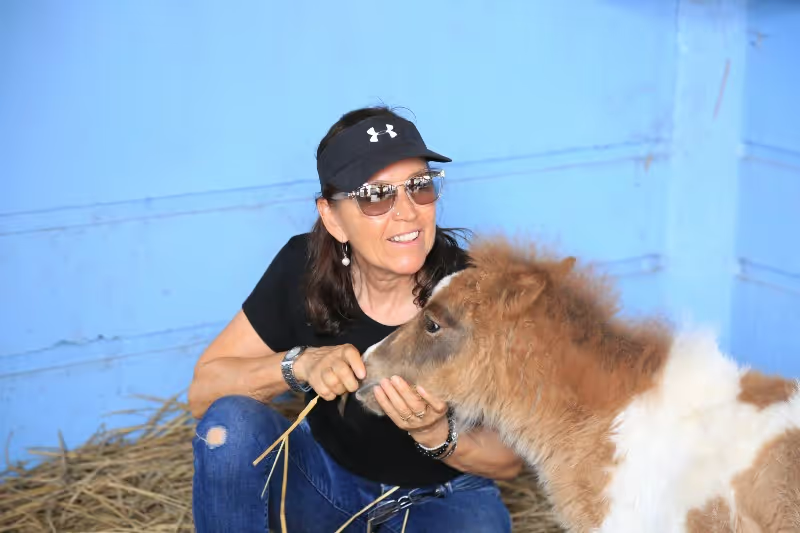
Indian equestrian sport has always lived at the margins of public consciousness technically demanding, resource-heavy, and long dominated by military structures. That reality began to shift decisively with Silva Storai, a figure whose impact spans from the racecourse to institution-building, and from individual excellence to ecosystem-level transformation.
Over three decades, Storai has not merely participated in Indian equestrianism; she has fundamentally reshaped how it functions, particularly on the civilian side . Storai’s journey to India itself reflects the resolve that would later define her work. Arriving in the country in 1978 at just 17, after travelling across Central Asia and the subcontinent, she forged an emotional connection that translated into long-term commitment.
Read Articles Without Ads On Your IndiaSportsHub App. Download Now And Stay Updated
What followed was not a romantic association but a deeply practical one learning, adapting, and ultimately embedding herself in a sporting ecosystem that had little space for women, civilians, or professional aspirations outside the Army.
Her breakthrough came in racing, where she became India’s first professional woman jockey after obtaining her licence in 1993. In a sport defined by physical risk and entrenched masculinity, Storai didn’t seek accommodation she competed head-on. Her achievements remain extraordinary even by global standards.
She is the only woman in the world to have won two Derbys, claiming the Hyderabad Derby in 2003 aboard Brown Sugar and the Mysore Derby in 2004 on Full Speed. The 2003 win stands out not just statistically but symbolically: nursing an injured horse through the final furlong, Storai combined technical brilliance with emotional control under extreme pressure.
Yet, her lasting influence extends far beyond personal medals. Even while racing professionally, Storai was laying foundations for something bigger. In 1996, she became Director of the Embassy International Riding School (EIRS) in Bengaluru, an institution that would later emerge as the cornerstone of modern civilian equestrian sport in India. Importantly, EIRS was established well before the market was ready. In the late 1990s, equestrianism was viewed as either a leisure hobby or an elite indulgence, not a career path. Storai’s decision to build world-class infrastructure at that stage reflected rare long-term vision.
Read Articles Without Ads On Your IndiaSportsHub App. Download Now And Stay Updated
EIRS was deliberately modelled on international benchmarks, particularly the British Horse Society (BHS) standards. This was not cosmetic compliance. It ensured that riders trained in India were learning techniques, safety protocols, and horsemanship aligned with global competition. The 240-acre Devanahalli campus, equipped with an international-standard jumping arena, signalled a shift from makeshift coaching to institutional excellence.
Crucially, Storai recognised that training alone would not solve Indian equestrianism’s stagnation. The competition structure was deeply flawed. Riders typically trained all year for a single national event, making performance peaks inconsistent and development difficult. Her response was the Equestrian Premier League (EPL) a structured, high-frequency competition model requiring riders to compete monthly over a fixed season. The effect was immediate: fitness standards rose, performance data became measurable, and South India emerged as a civilian powerhouse simply because it had consistent competition.
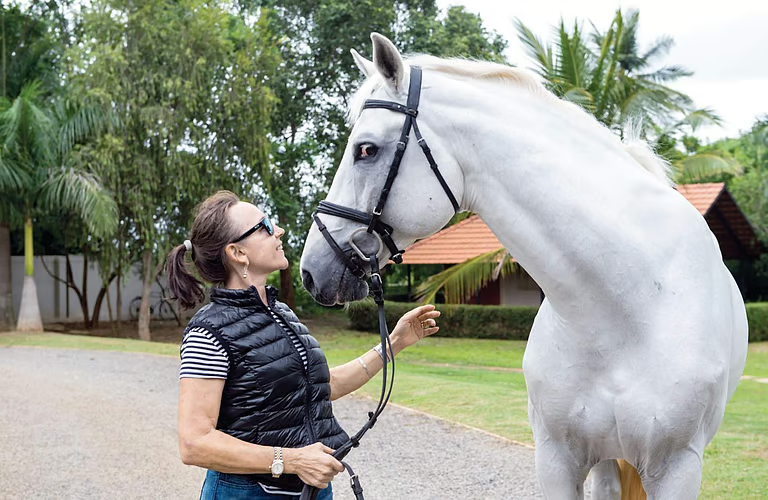
The clearest validation of this ecosystem came through Fouaad Mirza, India’s first equestrian Olympian since 1982. Supported by EIRS over 14 years and backed by unprecedented private investment, Mirza’s two silver medals at the 2018 Asian Games and his qualification for the Tokyo Olympics changed perceptions overnight. For the first time, Indian parents, sponsors, and institutions could see equestrian sport as capable of delivering global success. The ripple effect was tangible—riding clubs in Bengaluru multiplied almost tenfold in the years following.
However, Storai’s work has consistently existed in tension with broader governance structures. Indian equestrianism has long been dominated by military control within the Equestrian Federation of India (EFI). While the Army has provided vital infrastructure, bureaucratic rigidity and funding barriers have often stalled civilian progress. Storai has been vocal in arguing that sustainable growth requires empowered civilian governance, transparent administration, and facilitation of private capital rather than obstruction of it.
Beyond governance, she has also tackled one of the sport’s most overlooked constraints: horses themselves. At elite international levels, Warmblood horses are essential for eventing and jumping. India historically focused on Thoroughbreds for racing, creating a mismatch between supply and competitive needs. Anticipating this, EIRS began breeding Warmbloods domestically years ago an investment aimed at long-term sustainability. Recent policy changes removing import duties on Warmbloods only reinforce how accurate that diagnosis was.
Silva Storai’s legacy, then, is not singular but layered. She broke barriers as an athlete, set global benchmarks as an administrator, and proved that Indian equestrianism does not need to wait for systemic reform to succeed it can build parallel systems that work.

Her story is ultimately about architecture: designing structures that allow talent, investment, and ambition to coexist. Indian equestrian sport is still far from its global ceiling. But without Silva Storai, it may never have known such a ceiling existed at all.


