As the 2026 athletics season gathers momentum, India’s relay teams find themselves at a critical juncture. With the World Relays qualification window tightening, the focus has shifted sharply to timings, execution, and consistency across all four relay disciplines.
The latest standings underline both promise and pressure, with two Indian teams currently inside the qualification zone, while the remaining two face narrow but significant gaps.
At present, India’s women’s 4x100m relay team (43.86s, ranked 23rd) and the mixed 4x400m relay team (3:14.81, ranked 22nd) are inside the qualification cut-off. However, the men’s 4x100m and men’s 4x400m teams are just outside, ranked 25th and 27th respectively, while the women’s 4x400m team sits further back at 29th.
Men’s 4x100m: Margins That Define Qualification
India’s men’s 4x100m relay team is perhaps the closest to breaking into the top 24. With a current timing of 38.75 seconds, they need to shave off just 0.02 seconds to meet the projected qualification mark of 38.73 seconds.
While this appears marginal, sprint relays are defined by precision. The difference will likely come down to baton exchanges rather than raw speed. Encouragingly, India now has a cluster of sprinters running in the 10.18–10.22 second range, offering a strong base.
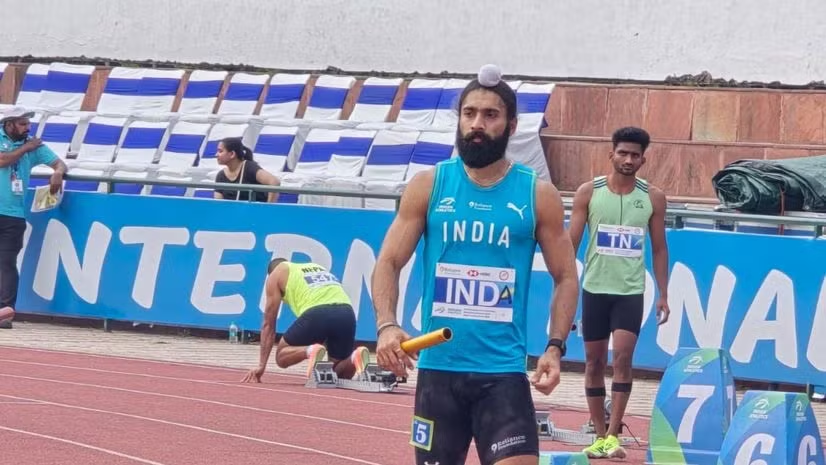
The challenge lies in translating individual speed into a seamless relay performance. Clean exchanges in the acceleration zones could be the deciding factor between qualification and disappointment.
Women’s 4x100m: Stability but No Room for Complacency
The women’s 4x100m team, currently ranked 23rd, sits within the qualification bracket. However, their position is far from secure. With global competition intensifying, any dip in performance could push them out of the top 24.
The current mark of 43.86 seconds provides a buffer, but not a comfortable one. Maintaining consistency across meets will be crucial. Unlike the men’s team, where qualification is about bridging a gap, the women’s team must focus on defending their position while aiming for incremental improvements.
Men’s 4x400m: Execution Under Pressure
India’s men’s 4x400m relay team, traditionally a strong unit at the Asian level, currently ranks 27th with a time of 3:03.67. The qualification benchmark stands at 3:03.42, meaning a 0.25-second improvement is required. In a one-lap relay, this is a significant margin. It demands not only faster splits but also optimal race strategy. Each leg must average under 46 seconds, with at least one or two runners dipping into the low 45-second range.
The depth in Indian quarter-milers is encouraging, but the team must deliver collectively. Baton exchanges, positioning during the break-in phase, and a strong anchor leg will all play critical roles.
Women’s 4x400m: A Steeper Climb
The women’s 4x400m relay team faces the toughest challenge among the four. Currently ranked 29th with a timing of 3:34.18, they need a significant improvement to reach the qualification mark of 3:31.37.
A gap of nearly three seconds in a relay event is substantial. Bridging it will require not just peak performances but also a re-evaluation of combinations and race strategy. India has historically been strong in women’s quarter-mile running, but the current scenario suggests a transition phase. Identifying a stable quartet and ensuring consistent sub-53 second splits will be key to closing the gap.
Mixed 4x400m: A Strategic Advantage
India’s mixed 4x400m relay team is currently in a relatively comfortable position, ranked 22nd with a timing of 3:14.81. This event has emerged as a strategic strength for India in recent years, combining the best male and female quarter-milers into a competitive unit.
However, like the women’s 4x100m team, their qualification is not guaranteed. Global standards are rising, and maintaining a top-24 position will require sustained performances across meets.
The mixed relay also offers tactical flexibility, particularly in the order of runners. Optimising this order based on strengths could help India not just qualify but also compete strongly at the World Relays.
The Bigger Picture: Execution Over Potential
Across all four relay events, a common theme emerges India has the individual talent, but qualification will depend on execution.
Relay races are unique in that they reward cohesion as much as speed. The ability to deliver under pressure, maintain rhythm, and execute flawless exchanges often separates top teams from the rest. With key events like the Open Relay Carnival and other domestic competitions providing opportunities to clock qualification times, the coming weeks will be decisive.
Win Exciting Prizes by Playing Sports Quiz – Download IndiaSportsHub App
The current standings present a mixed picture two teams inside the cut, two just outside, and one needing a significant push. But the margins, particularly in the men’s relays, suggest that qualification is well within reach. For Indian athletics, this is more than just a qualification race. It is an opportunity to establish relay teams that can consistently compete at the global level.
If the athletes can convert potential into performance, India could well see multiple relay teams line up at the World Relays marking a significant step forward in its sprinting ecosystem.