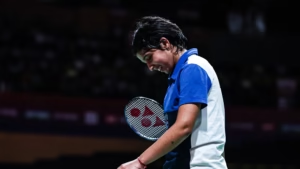
Indian women’s tennis received a timely shot of optimism at the ITF W15 Ahmedabad as 15-year-old Parthsarthi Arun Mundhe produced a standout run to reach the quarter-finals, navigating her way through the qualifying draw and upsetting established names in the main draw.
Competing against older, more experienced professionals on hard courts, Mundhe’s campaign underlined both her potential and the growing depth of India’s junior-to-pro pipeline.
The ITF W15 level is often described as the toughest entry point into professional tennis. With limited prize money but valuable WTA points on offer, these tournaments demand physical resilience, mental toughness, and consistency over multiple matches in quick succession. For an unranked teenager like Mundhe, the path to the latter stages was never going to be straightforward.
Mundhe’s journey in Ahmedabad began in the qualifying draw, where she was immediately tested. In the first round, she came through a three-set battle against Priyanka Rana of the USA, recovering from a slow start to win 3-6, 6-2, 10-7 in the match tie-break. The contest proved to be a defining moment early in the week, forcing Mundhe to problem-solve under pressure and adjust tactically rather than rely purely on instinct.
Read Articles Without Ads On Your IndiaSportsHub App. Download Now And Stay Updated
She followed that up with composed straight-set victories over Thaniya Sarai Gogulamanda and Chevika Reddy Sama, both from India, to book her place in the main draw. Clearing three qualifying rounds at a professional event is an achievement in itself, particularly for a 15-year-old still transitioning from the junior circuit. By the time she entered the main draw, Mundhe already had valuable match rhythm and confidence on her side.
That momentum carried into the first round of the main draw, where she faced Top seed Zeel Desai, one of India’s most experienced players at this level. Desai entered the match as a clear favourite, but Mundhe showed no signs of intimidation. She matched Desai from the baseline, absorbed pace effectively, and raised her level in key moments to clinch a hard-fought 7-6, 6-2 win. The opening-set tiebreak proved crucial; once Mundhe edged it, she played with greater freedom and authority in the second set.

The win over Desai was more than just an upset it was a statement. It highlighted Mundhe’s ability to compete with senior professionals and manage pressure situations that often unsettle younger players. Her clean ball-striking, willingness to step inside the court, and composure on return games stood out as markers of a player already thinking beyond her age group.
In the second round, Mundhe came up against another 15-year-old prospect, Aahan Aahan, in an all-Indian clash that showcased the promise of the next generation. While matches between peers often turn into tight, nervy affairs, Mundhe asserted control early and never let go. She won 6-3, 6-0, displaying superior depth, consistency, and physical intensity as the match progressed. The second-set bagel underlined not just technical superiority on the day, but also mental clarity an area where young players often fluctuate.
Read Articles Without Ads On Your IndiaSportsHub App. Download Now And Stay Updated
Reaching the quarter-finals set up a significant challenge for Mundhe against Ekaterina Yashina, a seasoned Russian professional with years of experience on the ITF circuit. The matchup represented a classic contrast: youth, speed, and ambition against experience, tactical variety, and match management. Regardless of the outcome, Mundhe’s presence at this stage of the tournament had already marked her as one of the standout performers of the week.
The broader significance of Mundhe’s run lies in what it says about Indian women’s tennis at the grassroots and junior levels. Playing a professional event at 15 and winning consistently is no longer an exception but an emerging trend. Regular hosting of ITF tournaments in India has reduced logistical and financial barriers, allowing young players to test themselves against international opposition without leaving the country.
For Mundhe, the Ahmedabad campaign is likely to earn her first WTA points, an important milestone that opens the door to higher-level ITF events. More importantly, it provides a clear reference point for where her game stands against professional benchmarks.
As Indian tennis looks to build a stronger presence on the global stage, performances like these matter. They indicate not just individual promise, but a system slowly beginning to support earlier and more confident transitions to the professional circuit. Parthsarthi Arun Mundhe’s week in Ahmedabad was not just about results it was about readiness. And at just 15, she already looks ready for what comes next