

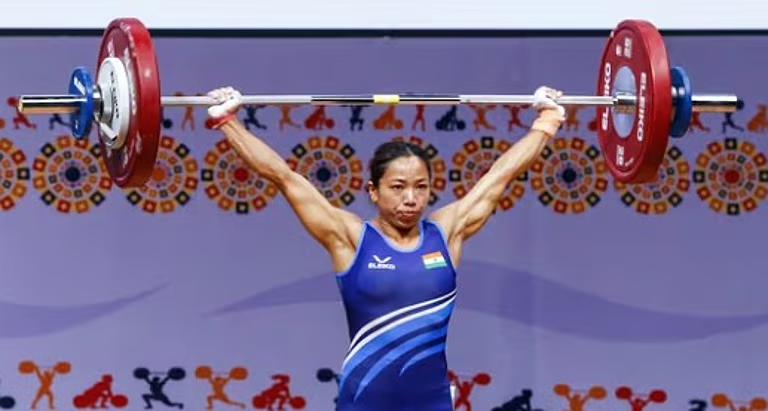
When the International Weightlifting Federation (IWF) released its finalized Olympic bodyweight categories for Los Angeles 2028, the ripple effect was immediate and in India, it hit hardest for one of the sport’s most beloved figures. Saikhom Mirabai Chanu, India’s Tokyo 2020 silver medallist and former world champion, now faces perhaps the most formidable challenge of her decorated career,adapting to a heavier weight class, recalibrating her training, and reigniting her motivation for a new Olympic cycle that has suddenly turned uphill.
For years, Mirabai Chanu has been synonymous with the women’s 49kg category one of the lightest and most competitive divisions in global weightlifting. It was in this class that she etched her name into Indian sporting folklore, winning Olympic silver in Tokyo and Commonwealth gold in Birmingham. But in the new LA28 framework, the IWF has officially removed the 49kg division from the Olympic program, leaving 53kg as the new entry point for women lifters .
This seemingly small four-kilogram increase is anything but trivial. For athletes like Mirabai, who maintain razor-thin margins between strength and body composition, moving up means re-engineering years of meticulously tuned training, muscle-to-weight balance, and nutrition strategies. It’s not just a question of adding mass it’s about gaining functional strength without compromising speed and technique.
At first glance, weightlifting’s LA28 overhaul appears positive: the sport will have six categories per gender instead of five, expanding from 10 medal events in Paris 2024 to 12. However, the unchanged athlete quota of 120 lifters (60 men and 60 women) means that each class will now feature only 10 competitors instead of 12. That reduction just two slots—may seem minor, but it significantly tightens the qualification field, making LA28 the most competitive Olympic cycle in recent weightlifting history .
For lifters like Mirabai, the implications are twofold. Not only must she adapt to a heavier class, but she must also do so in a qualification environment that allows almost no room for error. Even one off-day at a key qualifying meet could mean missing the Games altogether.
The 53kg Challenge: Can Mirabai Compete?
To be a serious contender in the new 53kg Olympic division, a total lift of approximately 215kg or higher (combined snatch and clean & jerk) is likely to be the benchmark for podium contention. That’s nearly 10 kilograms more than Mirabai’s Tokyo total (202kg), and several kilos above her personal best of 205kg achieved in competition.
It’s a formidable gap to bridge, especially for an athlete now in her 30s, whose injury history and technical precision define her lifting style. While Mirabai remains one of the best clean & jerk technicians in the world, her snatch historically her weaker lift would need to improve significantly to stay competitive at 53kg. The physiological demands of gaining lean muscle while retaining explosiveness will test every dimension of her experience and discipline.
Moreover, weightlifters moving up a class face challenges beyond pure numbers. The new competition pool will include lifters naturally suited to higher mass, many of whom train and compete comfortably above 52kg year-round. For Mirabai, competing against such athletes means she would likely need to permanently alter her training base and possibly her biomechanics no small undertaking this late in her career.
Beyond physiology and performance, motivation looms as the most crucial and unpredictable factor. After Tokyo, Mirabai had hinted that Paris 2024 might not necessarily be her final Games. However, after the removal of the 49kg class, that trajectory becomes uncertain. The psychological toll of essentially starting over building for three years toward an event where her best category no longer exists cannot be underestimated.
For an athlete who has already endured back injuries, qualification drama, and years of managing expectations as India’s lone female weightlifting icon, finding renewed purpose might prove more challenging than the training itself. “Will she even want to put her body through another Olympic cycle?” is a question many close followers of the sport are now asking.
A Body Blow to Lightweights Worldwide
Mirabai’s predicament reflects a broader issue with the IWF’s category reshuffle. By omitting the 49kg division, the federation effectively marginalized an entire class of elite lightweights who were the face of women’s weightlifting’s global rise. Countries like India, Thailand, Indonesia, and China—nations that have traditionally excelled in the 48kg/49kg bracket will now have to retool their Olympic pipelines.
The IWF’s rationale, centered on “athlete health and minimizing extreme weight cuts,” is scientifically sound but operationally punishing for those already optimized for lighter categories . It’s a trade-off between long-term sport reform and immediate athlete disruption. And in that equation, lifters like Mirabai find themselves caught in the crossfire of policy and performance.
If Mirabai chooses to chase one more Olympic medal, her path will be among the most difficult of her career. It would require a 30-month transformation gaining muscle mass without sacrificing her clean-and-jerk explosiveness, adjusting to new competition dynamics, and rebuilding international ranking points under an ultra-competitive 10-athlete-per-class format.
But if this marks the end of her Olympic road, it won’t diminish her legacy. Mirabai Chanu has already redefined Indian weightlifting winning global medals, inspiring a generation, and bringing the sport back into the country’s mainstream consciousness. Whether she takes one more shot at Los Angeles or not, the system’s structural changes have already ensured that her next move whichever direction it goes will symbolize the tension between reform and reality in modern Olympic sport.
In the end, LA28 may represent not just a new chapter for weightlifting, but a moment of reckoning for its greatest lightweights.
And for Mirabai Chanu, that chapter begins with one question: does the climb still feel worth it?


