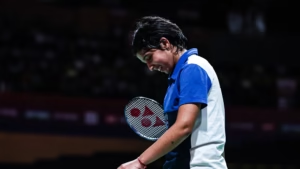
As India gears up to begin its Billie Jean King Cup Asia/Oceania Group I campaign against Thailand at the DLTA Stadium, the team has had to navigate a significant setback even before stepping onto the court.
The injury to one of its key players, Shrivalli Bhamidipaty, has forced a late reshuffle in the squad, testing both the depth and adaptability of the Indian side.
Shrivalli, who has been one of the promising names in Indian women’s tennis over the past year, was expected to play an important role in the campaign. Her absence not only disrupts the initial team balance but also removes a player who has consistently shown the ability to compete at a high level in international conditions.
Alongside her, Vaidehee Chaudhari has also been ruled out, compounding India’s selection challenges.
In response, Zeel Desai was called in at the last moment to complete the squad. While late inclusions can sometimes disrupt team rhythm, the Indian camp has taken a composed approach, framing the situation as an opportunity rather than a crisis.
Captain Vishal Uppal addressed the development with clarity, emphasising that the team’s strength lies in its growing pool of players. “If I have a problem picking players, it’s actually a good problem,” Uppal said. “It shows we have depth. Zeel was playing a tournament last week, and she immediately joined the team when called. That speaks about commitment and also about the options we now have.”

India’s squad now features Vaishnavi Adkar, Sahaja Yamalappalli, Ankita Raina, Rutuja Bhosale, and Zeel Desai a mix of youth and experience that will be relied upon to navigate a demanding group stage. The absence of Shrivalli, however, does shift additional responsibility onto the remaining players, particularly in the singles rubbers.
The timing of the injury is especially unfortunate for Shrivalli herself. Having steadily built her presence on the circuit, this tournament represented another opportunity to establish herself in the national setup. Injuries, however, remain an unavoidable part of elite sport, often testing not just the individual athlete but also the resilience of the team structure.
For India, the immediate task is to ensure that the disruption does not affect preparation or mindset. The team has spent the past few days training in Delhi, focusing on match readiness and acclimatisation. Uppal reiterated that while uncontrollable factors like injuries and weather exist, the emphasis remains on preparation and execution.
“We’ve had good practice sessions, and the team is ready to perform,” he noted. “The focus is on what we can control our effort, our planning, and how we approach each match.”
The injury setback also brings into focus the evolving depth in Indian women’s tennis. In previous years, the absence of a key player might have significantly weakened the team. Today, however, the presence of multiple competitive players provides a cushion, allowing the team to remain competitive even in adverse situations.
Veteran Ankita Raina highlighted this aspect, pointing out that familiarity with opponents and internal belief remain intact despite the changes. “We’ve played against many of these players before, so we understand what to expect. The preparation has been solid, and we’ll take it match by match,” she said.
For players like Vaishnavi Adkar and Sahaja Yamalappalli, the situation also presents an opportunity to step up in a high-stakes environment. Adkar, who recently became India’s No. 1, is set to make her debut in the competition and could now play an even more central role in the absence of Shrivalli.
The Billie Jean King Cup, by its very nature, is as much about team dynamics as individual performance. Injuries often reshape line-ups, but they also reveal the character and adaptability of a squad. India’s response to this setback will therefore be closely observed, not just in terms of results but also in how the team manages pressure and expectations.
As the opening tie against Thailand approaches, the focus within the Indian camp remains steady. The absence of Shrivalli Bhamidipaty is undeniably a loss, but it also underscores a broader narrative one of a team that is evolving, building depth, and learning to adapt.
In tournaments of this nature, challenges are inevitable. How a team responds often defines its campaign. For India, the journey begins with a test of resilience, shaped as much by preparation as by the ability to overcome early adversity.