
The 2025–26 Indian Super League (ISL) will not be remembered for glamour or expansion, but it may well define the most important reset phase in the history of Indian club football.
After months of uncertainty, administrative paralysis, and financial anxiety, the league’s return represents less a celebration and more a necessity, an effort to keep the professional ecosystem alive while Indian football confronts hard truths about governance, sustainability, and long-term structure.
At the heart of the crisis was the expiration of the Master Rights Agreement (MRA) between the All India Football Federation (AIFF) and Football Sports Development Limited (FSDL) in December 2025. That agreement had underpinned the ISL since its inception, controlling everything from commercial rights and broadcasting to league operations. Its end left a vacuum that neither side was prepared to fill quickly. A fresh tender process, overseen by a Supreme Court–appointed committee, failed to attract a single bidder, an alarming indicator of how fragile the league’s commercial value had become.
With clubs left in limbo and players facing months without clarity, the Sports Ministry stepped in during early January 2026. The intervention was blunt but necessary: Indian football could not afford another lost season. The outcome was a compromise—an ISL season conducted under AIFF supervision, with a drastically reduced format, limited financial exposure, and a clear emphasis on continuity over ambition.
Read Articles Without Ads On Your IndiaSportsHub App. Download Now And Stay Updated
The restructured 2025–26 ISL will feature 14 teams and just 91 matches, played in a single round-robin format between February 14 and May 31. Each club will face every other team once, meaning only 13 matches per side, less than half of what a traditional double round-robin would offer. Every fixture, therefore, carries disproportionate weight. There is no room for slow starts or mid-season recovery; one poor month could define an entire campaign.
To manage the league in the absence of a commercial partner, the AIFF has constituted a Governing Council Board tasked with overseeing operations, sponsorship, and broadcasting. While some clubs pushed for a fully club-owned league model, the final structure keeps the federation firmly in charge, with club representation built into decision-making. It is a temporary arrangement, but one that reflects the urgency of the moment rather than an ideal long-term solution.
Financially, the season is being run on austerity. The total operational budget stands at approximately ₹24.26 crore, with the AIFF contributing around ₹14 crore. The remaining costs are being shared by the clubs, each of whom has been asked to pay a ₹1 crore participation fee albeit with the flexibility to stagger payments over several months. Franchise fees have been waived, but that relief is offset by the absence of central revenue streams.
Broadcast income, once a key pillar, will be modest, with Doordarshan expected to play a significant role in coverage. Visibility may be retained, but commercial returns will be limited.
These constraints have had immediate consequences. Clubs have trimmed squads, renegotiated contracts, and reduced operational overheads. Player salaries, especially among domestic professionals, have come under pressure, and the transfer market has been noticeably subdued. This is a league in consolidation mode, not expansion.
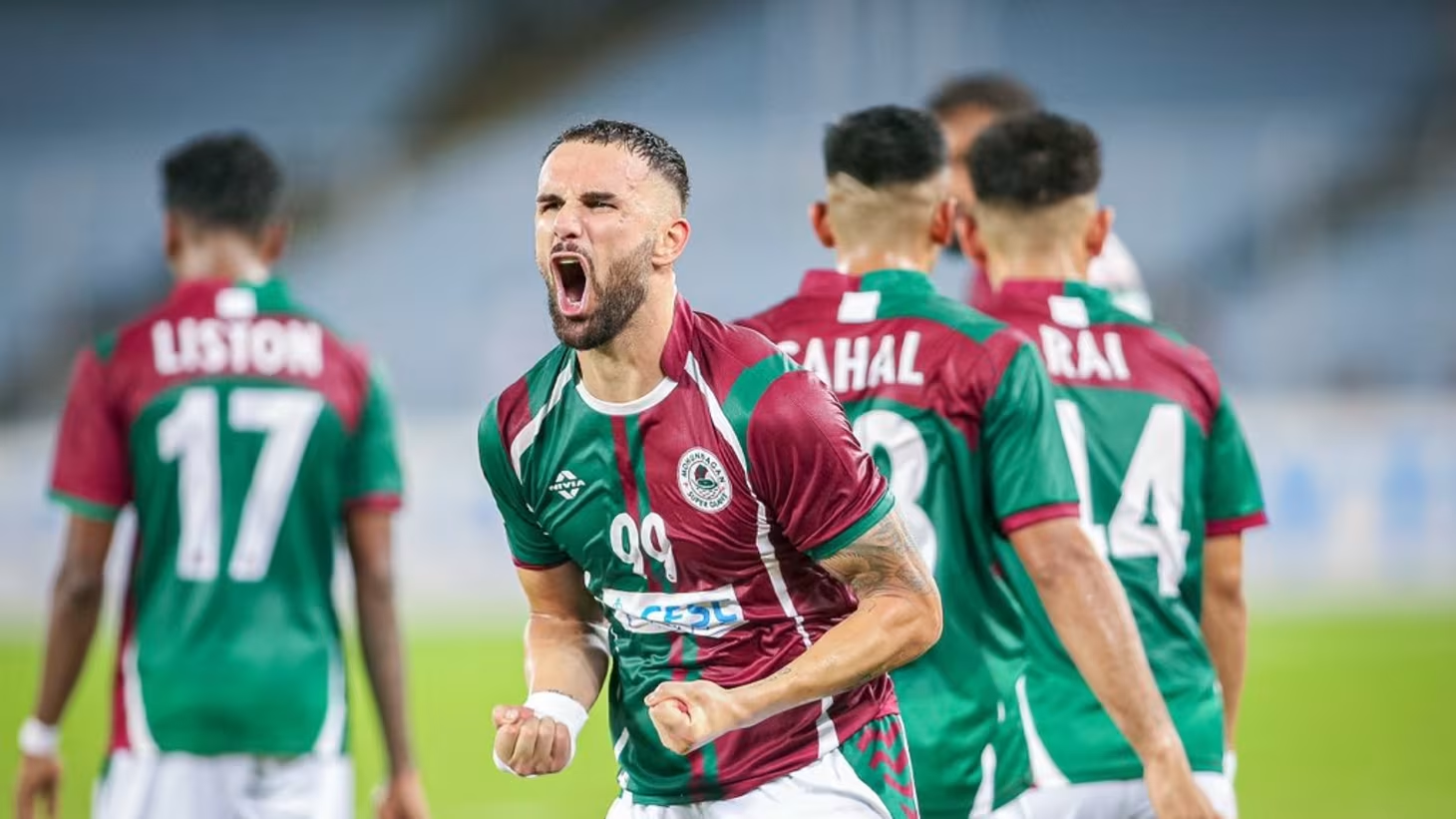
Geographically, the season also reveals interesting shifts. Kolkata remains a major hub, with Mohun Bagan Super Giant and East Bengal sharing the Salt Lake Stadium, while Mohammedan Sporting operates out of the Kishore Bharati Krirangan. The return of top-flight football to New Delhi is another notable development, with Punjab FC and the rebranded Sporting Club Delhi sharing the Jawaharlal Nehru Stadium. Meanwhile, newly promoted Inter Kashi, despite being based in Uttar Pradesh, will play their home games in Guwahati due to the lack of an AFC-compliant stadium in their home state. Their willingness to adapt underlines the compromises clubs are making just to ensure the league functions.
From a footballing perspective, the compressed calendar and reduced match count will test coaches in new ways. Preparation windows have been short, pre-seasons truncated, and tactical ambition tempered by physical realities. Experienced managers like Sergio Lobera and Antonio López Habas return to familiar environments, offering stability in uncertain times. At the same time, the presence of Indian head coaches such as Clifford Miranda and Renedy Singh signals a subtle shift—whether by design or necessity—towards greater domestic involvement in technical leadership.
The single-leg format also alters the competitive dynamic. Home advantage is diluted, long-term planning gives way to short-term execution, and depth becomes less valuable than immediate readiness. For supporters, this may reduce narrative arcs, but for players, it sharpens focus. Every point dropped is amplified.
Perhaps the most critical unresolved issue lies beyond domestic competition: continental qualification. With only 13 league matches, India falls short of the AFC’s minimum match requirements for club competitions. The AIFF has sought a one-time exemption to protect India’s continental slots, but the episode highlights how administrative instability can ripple outward, affecting credibility at the Asian level.
Ultimately, the 2025–26 ISL is not a vision of what Indian football wants to be it is a reflection of where it currently stands. This is a holding season, designed to preserve professional continuity while deeper questions are confronted. How should the league be governed?
Can it sustain itself without heavy central backing?
Is a club-owned or hybrid model inevitable? And most importantly, can football in India grow responsibly rather than rapidly?
If the ISL emerges from this season intact, with lessons absorbed and reforms initiated, 2025–26 may be remembered as the year Indian football stopped pretending and started rebuilding.


