

Indian rugby has witnessed several phases of growth over the past two decades, but no period has been as transformative or as strategically decisive as the two-year window between 2024 and 2025.
What began as a system driven largely by grassroots passion and scattered institutional support evolved into a professionally structured, commercially bankable and competitively ambitious rugby ecosystem. These twenty-four months marked an inflection point, where the country finally shifted from promise to process, from potential to planning, and from scattered participation to structured performance pathways.
The last two years reveal a clear story, India has chosen Rugby Sevens as its primary vehicle for continental relevance and commercial expansion, with the Rugby Premier League (RPL) emerging as the sport’s central engine. Alongside competitive highs, administrative reforms, coaching recruitment and grassroots reinforcement have turned rugby into one of India’s fastest-organizing Olympic-sport ecosystems.
The Pivot Year: 2024 Sets the Stage for Professionalization
The momentum began in 2024, a year that forced Indian rugby to confront its structural realities. The men’s 15s team struggled in the 2024 Asia Rugby Championship Division 1 in Colombo, finishing fourth after defeats to Sri Lanka and Qatar. The results were a stark reminder that the traditional format required far deeper investment than India was prepared to make.
More importantly, it revealed the disparity between the sport’s 15s and 7s trajectories. While the 15s programme lacked tactical depth and conditioning standards, the 7s structure had already started to show capability, especially among women.

Yet 2024 was also a year where administrative groundwork took shape. Corporate partnerships expanded through collaborations with Capgemini, which began to support both the IRFU’s technical development and its long-term transformation strategy. Grassroots participation through Khelo Rugby, “Get Into Rugby” programmes and state-level tournaments continued to draw thousands of young athletes, especially from rural and tribal belts.
But the true turning point came with the announcement at the end of 2024: a 10-year agreement between the Indian Rugby Football Union (IRFU) and GMR Sports to launch the Rugby Premier League.
That single partnership changed the trajectory of the sport.
2025: The Rugby Premier League Becomes India’s First Professional Rugby Property
Launched in early 2025, the Rugby Premier League (RPL) became the centrepiece of Indian rugby’s new era. For the first time, India had a league with:
- Six city-based professional franchises
- A dedicated 15-day window on the international sevens calendar
- Participation of 30 overseas marquee players
- Broadcast-ready production and commercial IP value
- Integration with the national 7s high-performance structure
The inaugural season in Mumbai immediately validated the IRFU–GMR vision. The Chennai Bulls emerged as champions, defeating the Delhi Redz 41–0 in a dominant display. Beyond the scoreboard, the RPL’s true impact lay in its role as a high-speed skill incubator. With Olympians such as Fiji’s Filipe Sauturaga and Joseva Talacolo competing alongside Indian players, the league became a masterclass in elite sevens rugby.
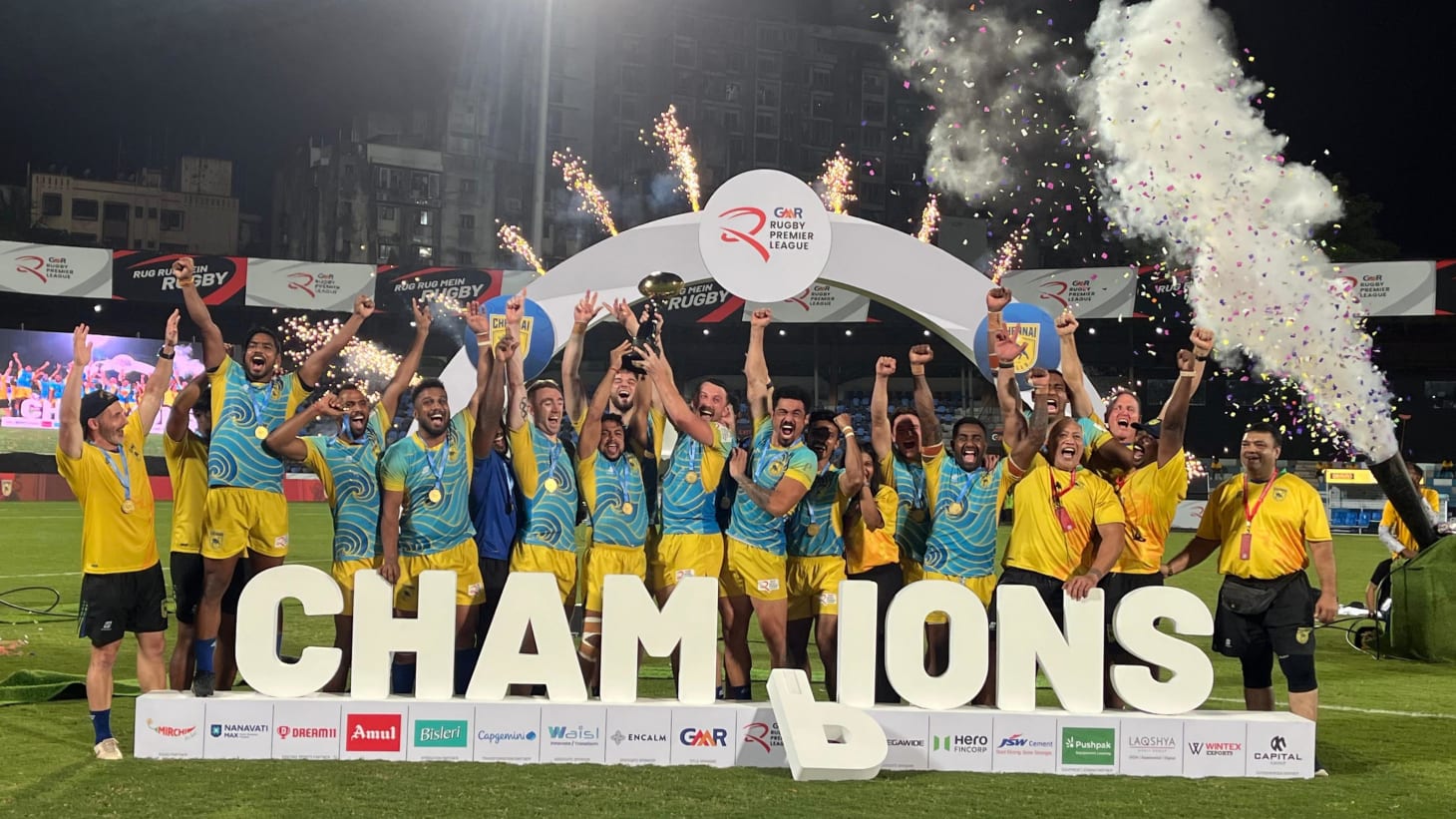
For domestic athletes names like Gaurav Kumar, Shanawaz Ahmed and Mohammed Ashique the exposure filled long-standing gaps in game speed, breakdown management, tactical reshaping and athletic conditioning. For a sport that had long been limited by domestic match tempo, the RPL gave India what it had lacked for decades: a professional environment and a sustained high-performance stimulus.
Indian Men’s Rugby Sevens: Promotion to Asia’s Top Tier
The most immediate competitive dividend of professionalization came in October 2025. At the Asia Rugby Emirates Sevens Trophy, India produced one of their most disciplined campaigns in years, finishing as runners-up and securing promotion to the Asia Rugby Emirates Sevens Series the continent’s top-tier competition. The tournament highlighted a team that had matured tactically and psychologically. Wins over Lebanon, Afghanistan and Saudi Arabia displayed consistency rarely seen in earlier cycles. Although India lost to Kazakhstan in the final, the overall performance signaled a new readiness for higher-level competition.

This promotion represents more than a medal; it is a structural achievement. It gives India regular exposure against Japan, Hong Kong China, Korea and other leading Asian teams experience vital for long-term development.
The Women’s 7s Team: Stable, Competitive, and Technically Reliable
While the men made headlines with promotion, the women’s side continued to demonstrate consistent regional competitiveness. The Indian women had earlier finished runners-up in the 2024 Asia Rugby Emirates Sevens Trophy and continued to hold their ground in the 2025 ARESS circuit, finishing sixth overall.
This steady progress underscores two truths: India already possesses a stable women’s talent base, and the domestic system for women supported by states like Odisha remains one of the best-structured in the country’s rugby landscape. The women’s team also benefitted from the same surge in coaching quality that reshaped the men’s programme, signaling that the IRFU views the development of both squads as equally crucial.
Read Articles Without Ads On Your IndiaSportsHub App. Download Now And Stay Updated
The last two years were also defined by high-profile coaching appointments that elevated India’s technical framework. The IRFU appointed Waisale Serevi the global “King of Sevens” as head coach for the national men’s and women’s 7s teams. Parallelly, Ben Gollings, who coached Fiji and later the RPL champion Chennai Bulls, served as operational coach during the 2025 promotion campaign. This dual-coach model is unique in Asian rugby. Serevi provides vision, knowledge architecture and global strategic alignment, while Gollings brings competition-ready execution.
Their complementary strengths have already reshaped India’s team culture, tactical systems and conditioning demands.
While 7s surged forward, the 15s programme continued to expose systemic limitations. India’s 4th-place finish in the 2024 Asia Division 1 Championship and a stagnant global ranking of 86 in 2025 highlight the widening development gap.
The contrast between both formats is stark:
- 7s has commercial viability, Olympic relevance, and a functional domestic league
- 15s requires larger squads, heavier infrastructure, and longer competitive cycles
Given India’s current developmental stage, it is clear why 7s has received strategic prioritization. Behind the elite advances lies a domestic system that has quietly become one of the sport’s most stable components.
Key developments from 2024–2025 include:
- The Senior National 7s Championships in Guwahati featuring 50 teams
- Chandigarh University dominating university-level competition in both 15s and 7s
- Bihar winning the Sub-Junior National 7s boys’ gold for the third consecutive year
- Odisha’s continued leadership in supporting high-performance training
These hubs Odisha, Chandigarh, Bihar form the backbone of the national talent pipeline. Replicating their development models across new states is a critical next step.
Corporate and Public Support: A Sustainable Financial Ecosystem Emerges
The last two years also marked significant financial stabilization. Beyond GMR Sports and Capgemini, NTPC’s partnership with the IRFU in 2025 brought rare public-sector endorsement to rugby. The authenticity of corporate confidence signals a deeper shift: rugby is no longer viewed as a niche sport but as a scalable product with commercial potential, especially in urban and university markets.
The period between 2024 and 2025 will be remembered as the most consequential phase in Indian rugby’s modern history. These years delivered:
- A professional league
- High-profile coaching
- Structural investments
- Competitive gains
- A defined national strategy
- A deepened grassroots ecosystem
For the first time, India has a coherent rugby identity centred on a fast-paced, Olympic-relevant and commercially sustainable format. The next two years will test the system’s resilience particularly India’s readiness for top-tier 7s competition but the foundations laid across 2024–2025 indicate that Indian rugby is finally on a pathway built not on hope, but on structure, strategy and sustained investment.


