
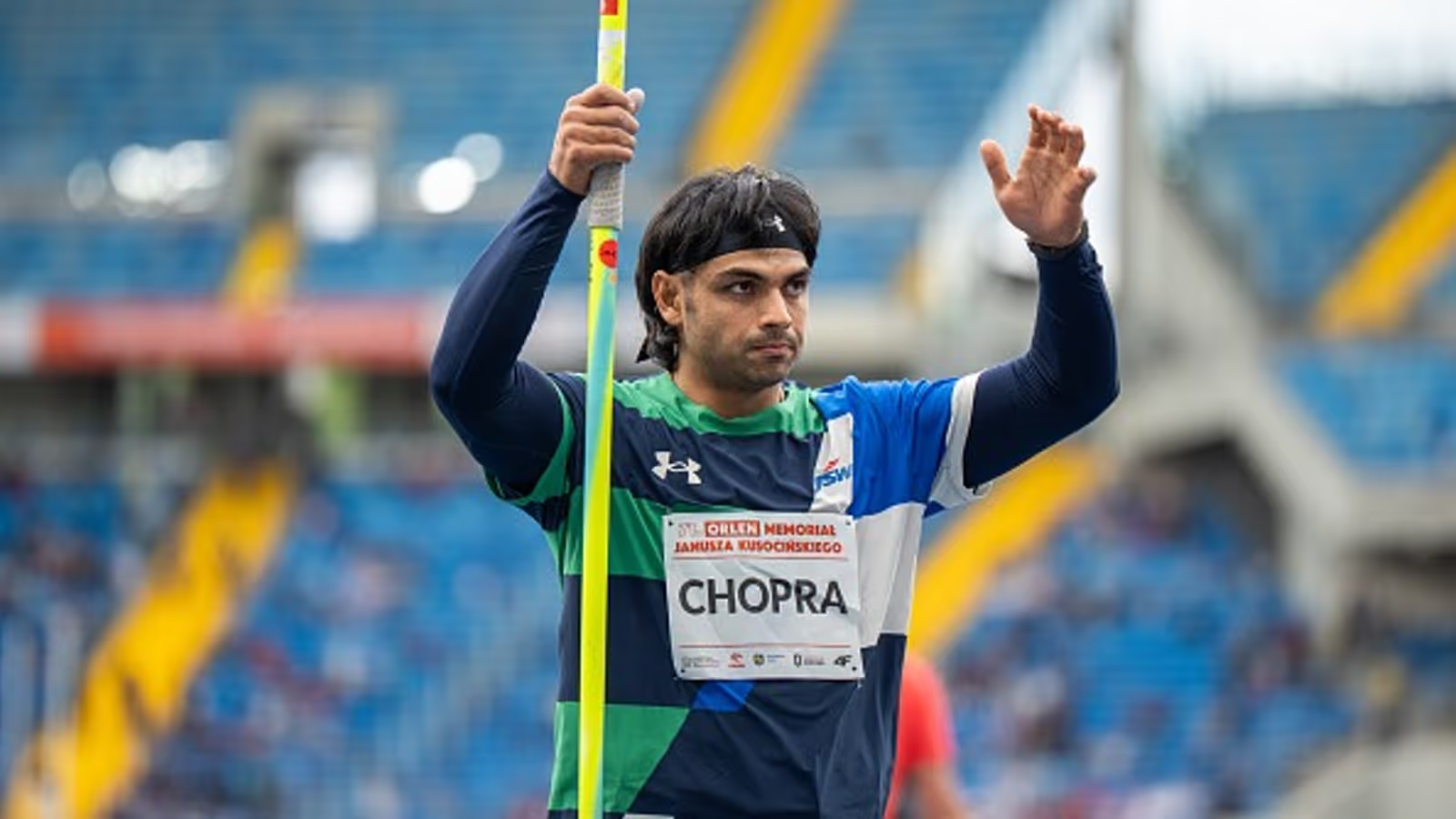
The 2025 season will stand as one of the most consequential years in the history of Indian athletics.
It was a year where headline-grabbing milestones coexisted with quieter but equally significant systemic shifts. While the global spotlight naturally gravitated toward the javelin runway and a long-awaited 90-metre throw, the deeper story of the season lay in the broadening of India’s competitive base across sprints, endurance, technical field events, and multi-discipline competitions.
For perhaps the first time, Indian athletics in 2025 felt less dependent on a single icon and more reflective of a maturing ecosystem.
The Javelin Standard Rises
Neeraj Chopra remains the axis around which Indian athletics turns, and 2025 delivered the moment many had waited for. At the Doha Diamond League in May, Chopra finally breached the 90-metre barrier with a throw of 90.23m, becoming the first Indian to do so. The mark was not merely symbolic; it was the product of technical refinement following his move to coach Jan Železný, particularly improvements in release velocity and stability through the final phase.

Yet even this historic moment carried a sobering undertone. Chopra finished second in Doha, underlining how global javelin standards have escalated. Consistency above 88 metres is no longer enough to guarantee podiums at the highest level, a reality reinforced by his eighth-place finish at the World Championships in Tokyo.
Read Articles Without Ads On Your IndiaSportsHub App. Download Now And Stay Updated
More telling, however, was the emergence of Sachin Yadav. On his debut at the World Championships, the 25-year-old threw 86.27m in the final outperforming Chopra and Pakistan’s Arshad Nadeem on the night and finishing fourth, just 40 centimetres short of a medal. That performance, backed by a silver medal at the Asian Championships, confirmed that Indian javelin has finally developed internal depth rather than relying on a lone spearhead.
A significant institutional milestone arrived with the launch of the Neeraj Chopra Classic in Bengaluru. As India’s first World Athletics Gold-level meet, it signaled a shift in ambition from exporting athletes abroad to importing elite competition home. The sight of a full stadium watching world-class field athletes compete in India marked a cultural turning point. For domestic athletes, it provided rare exposure to top-tier competition without leaving the country, a crucial step in bridging the performance gap at global finals.
Speed Finds Its Voice
Perhaps the most unexpected breakthrough of 2025 came on the track. Indian sprinting, long viewed as a developmental weak spot, delivered tangible progress. Animesh Kujur emerged as the fastest Indian man in history, setting national records of 10.18 seconds in the 100m and 20.32 seconds in the 200m. More importantly, he became the first Indian male sprinter to qualify for the World Championships in the 200m.
This progress extended beyond individual brilliance. The men’s 4x100m relay squad broke a 15-year-old national record with a time of 38.69 seconds and later claimed bronze at the FISU World University Games. The emphasis on baton exchanges and role clarity suggested a long-term relay strategy finally taking shape.
In the 400m, Vishal TK’s national record of 45.12 seconds signalled a generational shift in the quarter-mile, strengthening India’s relay prospects in an event where medals remain realistic at the continental level.
Read Articles Without Ads On Your IndiaSportsHub App. Download Now And Stay Updated
If sprinting was about speed, 2025 was equally about stamina. Gulveer Singh delivered one of the most statistically dominant seasons ever by an Indian distance runner. He became the first Indian to run sub-13 minutes in the 5000m, shattered the national record in the 10,000m, and claimed a rare Asian double in Gumi.
Yet the World Championships offered a reality check. Gulveer missed the 5000m final by less than two-tenths of a second and finished 16th in the 10,000m final. The performances confirmed his world-class credentials while also exposing the razor-thin margins that separate finalists from also-rans at global level.

Indian athletics also made quiet but historic strides in technical field events. Sarvesh Kushare became the first Indian high jumper to reach a World Championship final, finishing sixth with a personal best of 2.28m. His consistency throughout the season hinted at sustainability rather than a one-off peak.
On the women’s side, 18-year-old Pooja Singh ended a 25-year gold medal drought in the Asian Championships high jump, underlining the potential of grassroots pipelines when supported with structured coaching. In pole vault, Dev Meena pushed the national record to 5.40m and reached a World University Games final still distant from global standards, but evidence that India is finally addressing neglected disciplines.
Cracks Beneath the Surface
Despite the medals and records, 2025 also exposed uncomfortable truths. India’s doping problem cast a long shadow, with over 100 athletes under suspension. The gap between qualification and final-round performance at global championships also widened, pointing to deficiencies in championship-specific preparation and mental conditioning.
A leadership change at the Athletics Federation of India adds further uncertainty, placing responsibility on the new administration to preserve momentum while tightening governance and anti-doping enforcement.
Read Articles Without Ads On Your IndiaSportsHub App. Download Now And Stay Updated
As India looks toward the Commonwealth Games in Glasgow and the Asian Games in Nagoya, the contours of a new athletics identity are visible. Speed, endurance, and technical depth are no longer isolated successes but part of a broader pattern.
The challenge now is conversion turning records into finals, and finals into medals.
If 2025 was about possibility, 2026 will be about proof.


