India’s bid to defend their crown at the Badminton Asia Team Championships 2026 begins under very different circumstances from two years ago.
When the women’s team created history in Malaysia in 2024 by winning their first-ever continental team gold, it was powered by the presence of P. V. Sindhu, the heartbeat of Indian badminton for more than a decade. This time, in Qingdao, China, the defending champions will have to chart a new path without her, after Sindhu was forced to withdraw because of a niggle.
The loss of a two-time Olympic medallist and multiple-time world championship medallist is never easy to absorb, especially in a team format where experience and leadership often tilt close ties. But if the past two years have shown anything, it is that Indian women’s badminton has entered a phase of depth and renewal. The onus now shifts to a young core that is no longer just promising but increasingly proven.
Tanvi Sharma leads a new generation
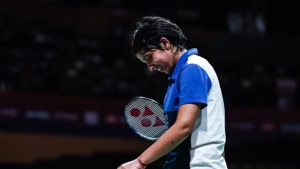
At the forefront of this new wave is Tanvi Sharma, the 17-year-old from Punjab who is set to shoulder a central role in Qingdao. Tanvi was part of the gold-winning squad in 2024 but did not get on court then. Since that breakthrough, however, she has built a résumé that suggests she is ready for the spotlight. A silver medal at the World Junior Championships in Guwahati and a runner-up finish at the US Open Super 300 marked her arrival on the senior stage.

Her start to 2026 has been equally encouraging. Pushing World No. 2 Wang Zhi Yi and World No. 9 Tomoka Miyazaki to three games at the India Open and Indonesia Masters has underlined her ability to compete with the elite, even if the wins have not yet followed. In a team environment, those performances could be invaluable in giving India competitive singles points against Asia’s best.
Alongside her is Unnati Hooda, another teenager who has already tasted what it means to beat the biggest names. The 18-year-old climbed to a career-best world ranking of 23 in 2025 and memorably defeated Sindhu at the China Open. She capped that season with the Odisha Masters title, adding to her reputation as the youngest Indian to win a BWF Super 100 event. Hooda’s fearless attacking style and growing consistency make her a vital weapon in India’s singles lineup.
Malvika Bansod and Rakshitha Sree Santhosh Ramraj will complete the singles rotation, giving the coaching staff flexibility to match players tactically against different opponents in Group Y, where India begin against Myanmar before a tougher clash with Thailand.
Doubles stability amid change
If singles is where the uncertainty lies, doubles remains India’s pillar. Commonwealth Games bronze medallists Gayatri Gopichand and Treesa Jolly will once again anchor the women’s doubles. The pair ended 2025 by defending their Syed Modi International title, a sign of their growing maturity and understanding on court. With Tanisha Crasto, Priya Konjengbam and Shruti Mishra in support, India’s doubles bench has enough depth to absorb pressure moments.
The challenge for the women will be psychological as much as tactical. Without Sindhu’s presence in crunch ties, the younger players will have to learn quickly how to handle the weight of expectation that comes with being defending champions.
Men banking on experience
On the men’s side, the narrative is more about continuity. India, bronze medallists in 2016 and 2020, still carry the aura of their historic Thomas Cup triumph in 2022, and much of that core remains intact.
Leading the charge is Lakshya Sen, now a settled top-15 player on the world circuit. His Australian Open title last year and a run to the Hong Kong Open final showed that he can deliver at big events. He will be supported by Kidambi Srikanth and H. S. Prannoy, both former world championship medallists whose experience in high-pressure team matches remains invaluable, even if their recent form has fluctuated.
Youth also has a role here. Ayush Shetty, the US Open Super 300 champion, and Tharun Mannepalli provide fresh energy and tactical options in singles.
In doubles, all eyes will be on Satwiksairaj Rankireddy and Chirag Shetty, the two-time world championships bronze medallists. After a relatively modest start to the season, they will be eager to rediscover the explosive form that once made them world No. 1.
Drawn in Group C, India open against Singapore before a sterner test versus Japan. With the top two teams advancing to the quarterfinals, a strong start will be critical.
Read Articles Without Ads On Your IndiaSportsHub App. Download Now And Stay Updated
As the Badminton Asia Team Championships get underway, India’s men and women face contrasting challenges. The men lean on experience and proven pedigree to chase another podium finish. The women, deprived of their talisman, must rely on youth, belief and the growing depth of Indian badminton to defend a title that once seemed improbable.
In Qingdao, the spotlight will not just be on results, but on how this new generation responds when history asks them to step forward.