
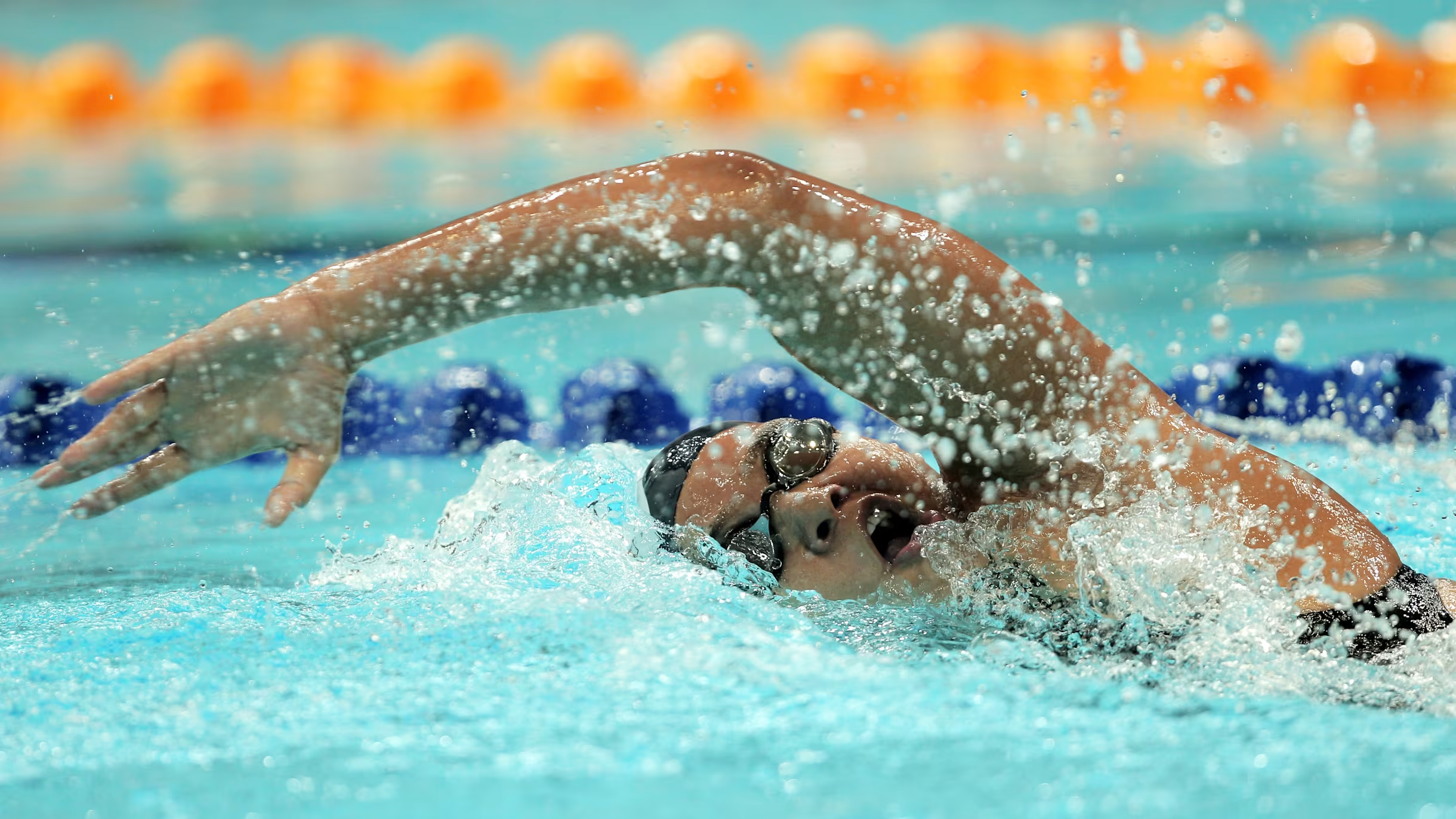
Swimming is one of the most competitive sports at the Olympics.
In this sport, milliseconds can make the difference between winning and losing, and legends are only a fraction of a second behind the rest of the pack. The United States, Australia, China, and some parts of Europe are at the top of the world leaderboard. But swimming in India has been getting bigger and bigger, even though it still has a long way to go before it can compete with the best in the world.
The Global Elite: What Does “World-Class” Look Like?
Before we can figure out where India stands, we need to know what the best swimmers in the world can do.
World-class swimmers keep going beyond what they think they can do:
- Katie Ledecky : Many people think that Katie Ledecky from the United States is the best female swimmer of all time. She has won a lot of medals at the Olympics and World Championships and set many world records in the women’s 800m and 1500m freestyle events.
- Caeleb Dressel is the best person in the US at sprint freestyle and butterfly. He holds the world record for the 100m fly and a lot of other short distances.
- The world records for the most important Olympic events are very fast. For example, the world record for men in the 100m freestyle is about 46 seconds, while the best times for women in the same event are less than 52 seconds.
- Over time, the time it takes to get to the semifinals or finals has gotten shorter. For example, it now takes the men about 47 to 48 seconds to get to the semifinals in the 100 m freestyle.
These times show years of specialized coaching, scientific training, great facilities, and a tradition of competition that many countries pass down from generation to generation.
India’s Swimming Landscape: Improving But Behind
India’s swimming is getting better, but it still doesn’t do as well at international meets as it could. Some Indian swimmers have done well on the world stage, but most of their results are still not good enough to win medals or make it to the finals.
The results of the Olympics and the World Championships
- Srihari Nataraj: One of the best swimmers in India is Srihari Nataraj. He has competed for his country in the Olympics in Tokyo in 2020 and Paris in 2024. In the 100m backstroke heats in Paris, he came in 33rd overall with a time of 55.01 seconds. He didn’t make it to the semifinals. He currently holds multiple national records.
- Tanish George : Indian swimmers like Tanish George (50.58s in the 100m free) and others have taken part in the World Aquatics Championships, but most of them came in 30th or 40th place in their events.
- Two more Indians who have competed at the World Championships are Sajan Prakash and Shoan Ganguly. However, they did not finish in the top 30–40 in events like the 200m freestyle or the 200m medley.
These results show that India is swimming at the highest levels, but there is still a big gap between them and the best swimmers in terms of time and placement.
How India’s Best Compared to the Rest of the World
Men’s 100m Freestyle
- India’s best time was about 49.4 seconds. A time between 46.4 and 47.0 seconds is world-class. There is a 2.5 to 3 second gap.
- Effect: A 3-second gap in sprint swimming is a lot. At international competitions, a 0.5-second difference can mean losing 10 to 15 spots. India’s best times don’t meet the standards for getting to the semifinals of the Olympics, though.
Men’s 200m Freestyle
- India’s best time was between 1:51 and 1:52. The best time in the world is between 1:44 and 1:46. There is a break that lasts between six and eight seconds.
- Impact: This difference is almost half the length of a pool when it’s going as fast as it can.
- Fact: Indian swimmers don’t make it to the top 30 at the World Championships.
Men’s 800m Freestyle
- 8:00 to 8:01 is the best time for India. 7:38 to 7:41 is the best time in the world. Gap is More than 20 seconds
- Impact: This gap shows that there are differences in aerobic capacity, pacing, and experience with racing at the highest levels of endurance.
Indian swimmers are not even close to the end of the race or winning a medal in long-distance events. The times are different now. For instance, it takes 10 to 20 seconds longer for the 200m, and it takes more than a minute for longer distances. This shows that there is still a gap in both physical and technical skills.
Women’s Freestyle
India has made some great young swimmers who have broken national and Asian age group records. Dhinidhi Desinghu, for instance, had the fastest Indian 100m freestyle time at the Asian Group Aquatics Championships. But these times are still a long way from the times needed to win medals at the world championships.

Important Indian Records, Titles, and Other Achievements
India hasn’t won any finals at the Olympics or World Championships yet, but there are some big things to be proud of:
Breakthroughs on the National and Regional Levels
- Srihari Nataraj has broken more than a dozen Indian national records and gotten faster in both backstroke and freestyle sprints.
- The sport is getting more popular because Indian youth swimmers are setting national records at Asian championships and youth meets.
What caused the gap? Structural and Systemic Factors
There is more to the difference between Indian swimmers and world-class rhythms than just talent. The system also plays a role:
Training Infrastructure: The best swimming countries have world-class high-performance centers that offer sports science support, training at high altitudes, detailed biomechanical feedback, and competitive circuits all year round. India still needs more access to these kinds of great facilities.
A culture of competition: The US and Australia have had professional swimming for decades. They have college systems, yearly national leagues, and international competitions. Indian swimmers don’t often get to race when they have to go really fast and deal with a lot of stress.
When elite swimmers are 8 to 10 years old, they often start training like professionals, with a clear path to college and national teams. Structured early training is hard to come by in India, and when it is, it’s only in a few places.
Financial and Coaching Investment: Many world champions get help from sponsors, full-time coaches, and mental health services. Putting more money into coaching and funding athletes in India could help make competitions better more quickly.

How Swimming Will Change in India in the Future
1. Young swimmers in India are already winning medals at international youth events and breaking records for their age groups. Adding structured coaching and competition to this model can help create a pipeline.
2. Putting money into high-end swimming pools with full support services, like nutritionists, sports science, and world-class facilities, will help close the gap.
3. Competing and being seen Sending more athletes to high-level meets all over the world all the time will help them get better at racing and make them more competitive.
The numbers show that India is in the Olympics and the World Championships. In big events, Indian athletes usually run a few seconds slower than the best times in the world. Indian swimmers don’t often make it to the semifinals or finals of the World Aquatics Championships or the Olympics. But things are getting better in India because the country is getting stronger and people are seeing more of the world.
India’s swimming has come a long way since not many people knew about the country. Today, Srihari Nataraj and other young swimmers who are getting better look very promising. India’s times are still slower than those of world champions like Katie Ledecky and Caeleb Dressel, as well as the best finalists whose times are close to world records. India can catch up, but it needs to keep building better infrastructure, giving its swimmers more chances to compete, and putting money into the system if it wants to make world-class swimmers. India may not have as many medals as it used to, but it does have hope, passion, and progress.
Things are changing in swimming, and the world map could change in the next ten years.


