
The global chess circuit has increasingly become a high-stakes professional ecosystem, where elite performance is now rewarded not just with prestige, but with significant prize money, while Gukesh Dommaraju was placed at 17th.
A look at the latest prize earnings table from major events over the season offers a telling snapshot of where the world’s best stand and more importantly for Indian chess, how firmly India’s new generation has embedded itself among the global elite.
At the very top of the list sits Magnus Carlsen, whose $1.45 million in prize money across 16 events underlines both his sustained excellence and the commercial gravity he brings to every tournament he plays. Fabiano Caruana, Levon Aronian, and Hikaru Nakamura follow, representing a familiar core of established stars who continue to dominate the elite circuit. Their presence at the top reflects the depth of experience and consistency required to cash in regularly at the highest level.
Read Articles Without Ads On Your IndiaSportsHub App. Download Now And Stay Updated
What stands out immediately, however, is the prominence of Indian names in this landscape no longer as outliers, but as regular fixtures.
Arjun Erigaisi, ranked eighth overall with $431,214 earned across 16 events, has quietly become one of the most reliable performers on the circuit. His earnings place him ahead of several more established European names, highlighting not just flashes of brilliance but sustained competitiveness. Arjun’s consistency across formats and tournaments has translated into regular deep runs, and while his best single-event prize of $115,000 may not yet match the very top earners, the volume of events and steady returns reflect a player firmly embedded in the global top tier.
Just below him sits R Praggnanandhaa, ranked 12th with $317,122 from 14 events. Praggnanandhaa’s season reflects a slightly different profile — fewer headline-grabbing paydays, but an unmistakable presence in elite fields. His best prize of $77,667 may seem modest compared to the six-figure hauls higher up the list, but context matters. For a player still in his teens, competing regularly against world champions and Candidates-level opposition, this level of financial return is indicative of long-term sustainability rather than short-term spikes.
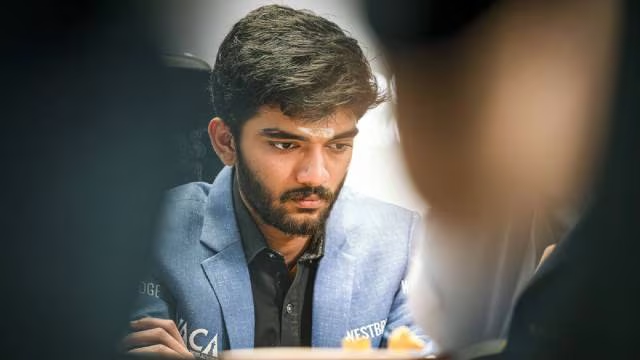
Perhaps most telling is the presence of Gukesh Dommaraju at 17th, earning $202,292 across 13 events. While his best prize of $63,000 is among the lower figures in the top 20, Gukesh’s trajectory is unmistakably upward. Unlike some players higher on the list who rely on occasional deep runs in fewer events, Gukesh’s earnings are spread across a busy competitive calendar a sign of increasing trust from organisers and invitations to top-tier events.
Read Articles Without Ads On Your IndiaSportsHub App. Download Now And Stay Updated
What binds Arjun, Praggnanandhaa, and Gukesh together is not just nationality, but timing. They are entering their prime years at a moment when chess is undergoing rapid professionalization. Bigger prize funds, more elite events, and greater commercial visibility mean that consistent performers are rewarded more than ever. Indian players are no longer dependent on a single breakthrough tournament; they are building season-long campaigns comparable to their European and American peers.
Globally, the list also reflects a shifting balance. Young stars like Vincent Keymer, Alireza Firouzja, and Nodirbek Abdusattorov sit comfortably alongside veterans, while women’s world champions like Ju Wenjun and Tan Zhongyi underline the increasing financial parity at the very top of the women’s game.
For India, the takeaway is clear. This is no longer a story of potential or promise. The numbers show that Indian grandmasters are already operating at global standards not just in Elo ratings or headline wins, but in the hard currency of elite sport: prize money earned through consistent, high-level performance.
As the calendar expands and prize pools grow, India’s presence in the upper reaches of global chess looks not just secure but set to strengthen further.


