
Rugby union in India is a story layered with paradox.
It is one of the oldest sporting codes played on Indian soil, yet remains one of the youngest in terms of structured national ambition. Its roots stretch back to the 19th century under the British Raj, and its most famous legacy the Calcutta Cup is contested annually between England and Scotland.
Yet, more than a century later, Indian rugby is still carving out its own competitive identity on the continental stage.
The modern journey of Rugby 15s in India, particularly between 2022 and 2026, reflects a sport transitioning from heritage nostalgia to high-performance intent.
The Colonial Origins and the Calcutta Cup Legacy
Rugby arrived in India in the early 1870s through British military regiments. The first recorded matches were played in Calcutta (now Kolkata), and by 1873, the Calcutta Rugby Football Club had been formally established. Within a few years, it became affiliated to the Rugby Football Union (RFU) in London. When the club disbanded in 1877 due to declining membership, its remaining funds 270 silver rupees were melted down and crafted into a trophy.
That trophy became the Calcutta Cup, first contested in 1879 between England and Scotland.
While the Cup went on to become one of rugby’s most storied international trophies, rugby in India entered a quieter domestic phase, sustained by clubs such as Calcutta Cricket and Football Club and Bombay Gymkhana.

The modern administrative framework was established in 1998 with the formation of the Indian Rugby Football Union (IRFU), commonly known as Rugby India. In 1999, India became a full member of World Rugby and joined Asia Rugby, marking its formal entry into the international rugby structure.
The sport’s professional trajectory accelerated significantly in the 2020s under a leadership model that emphasized grassroots expansion, women’s participation, and high-performance structures.
A critical turning point was the partnership with the Government of Odisha in 2020. Bhubaneswar’s Kalinga Stadium became the national high-performance hub, and for the first time, players received structured financial and medical support. This shifted rugby from a volunteer-driven pursuit to a semi-professional ecosystem.
Men’s 15s: From Regional Dominance to Continental Reality
The 2022–2024 competitive cycle defined the current status of Indian men’s Rugby 15s.
2022: Dominance in Division 3 South
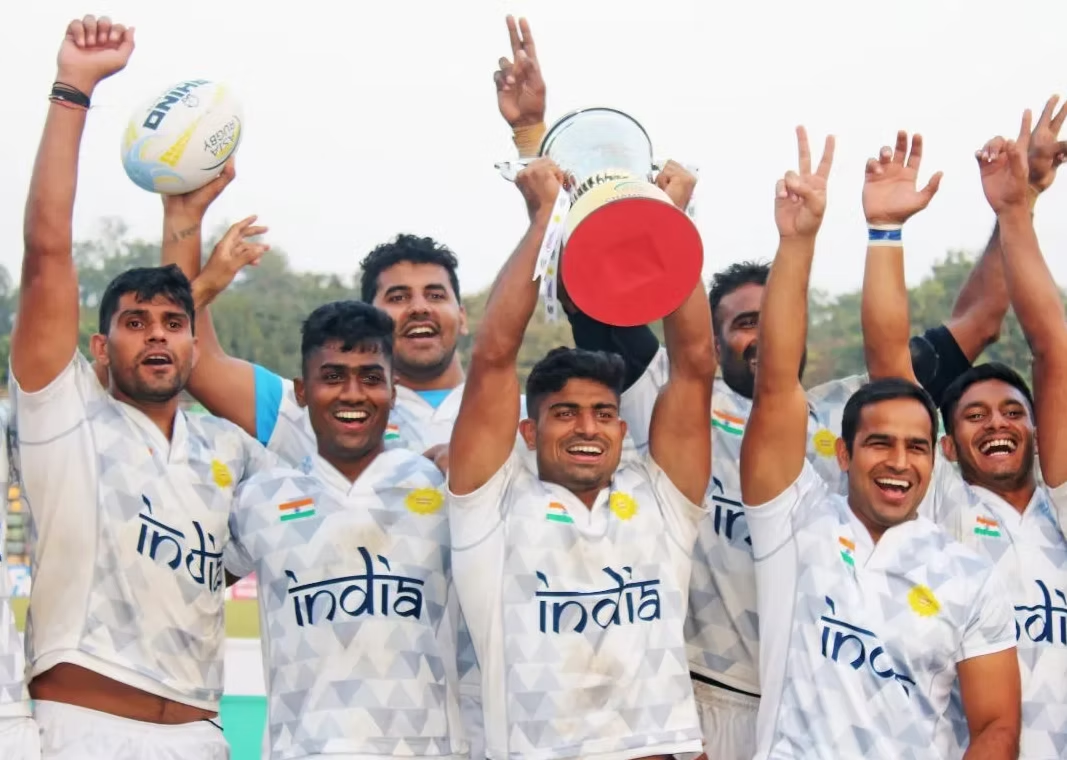
India hosted the in Kolkata and overwhelmed Nepal (86–0) and Bangladesh (82–0) to secure promotion. These victories highlighted India’s growing physicality and conditioning within the South Asian context.
2023: The Step Up in Division 2
The 2023 Division 2 Championship in Doha exposed the gap between regional dominance and continental competitiveness. India lost to Qatar (7–32) and Kazakhstan (22–29). The latter match was competitive but underscored late-game discipline and tactical management deficiencies.
2024: Division 1 and World Cup Pathway
In Colombo, India competed in Division 1, which doubled as part of the Rugby World Cup 2027 qualification pathway. A heavy semi-final defeat to Sri Lanka (10–45) was followed by a competitive but unsuccessful third-place playoff against Qatar (25–34).
As of late 2024, India ranked 89th globally in men’s 15s .
The pattern was clear: India can dominate at the sub-regional level but must improve set-piece efficiency, tactical kicking, and defensive structure to challenge Division 1 mainstays.
Women’s 15s: Faster Acceleration, Stronger Identity
India’s women’s Rugby 15s program has progressed more rapidly in relative terms.
The team secured its first international Test victory in 2019 against Singapore and has since built a structured pipeline through domestic competitions and grassroots participation. Currently ranked 55th globally, with a historic high of 50th in 2024 , the women’s team benefits from over 40% female participation in the “Get Into Rugby” grassroots program.
The 2024 National Rugby 15s Championship saw Odisha RFC dominate, defeating Delhi Hurricanes 69–5 in the final. This success reflects the Odisha high-performance model’s impact on women’s development.
Watch Indian Live Scores and Play Quiz – Download IndiaSportsHub App
The All India & South Asia Rugby Tournament, contested since 1924, remains the premier domestic 15s competition. Clubs such as Bombay Gymkhana and Calcutta CFC continue to anchor India’s rugby tradition. Simultaneously, the launch of the Rugby Premier League (RPL) in 2025 introduced a franchise-based commercial model. Although focused on sevens, its professional standards influence conditioning and skill transfer into the 15s format.
This dual structure heritage tournaments alongside modern leagues defines India’s rugby identity today.
India’s coaching philosophy has evolved from short-term tournament appointments to sustained development programs. The appointment of Waisale Serevi in 2024 as sevens head coach introduced elite-level technical standards and conditioning culture. Though primarily linked to sevens, this high-performance discipline is filtering into the 15s squad’s approach.
The current men’s squad composition reflects geographic diversification, with strong representation from Delhi Hurricanes, Odisha RFC, and Bombay Gymkhana. This indicates the shift from a Kolkata-Mumbai dominance model to a broader national spread.
Watch Indian Live Scores and Play Quiz – Download IndiaSportsHub App
The immediate objective is promotion within Asia Rugby’s divisional structure, with December 2026’s Division 1 tournament in Malaysia identified as a key milestone.
Long-term targets include:
- Breaking into Asia’s top-tier championship.
- Establishing sustained competitiveness against Sri Lanka, Qatar, and Kazakhstan.
- Strengthening women’s pathways toward elite Asian competitions.
- Leveraging Olympic-driven sevens exposure to raise 15s standards.
The expansion of the Rugby World Cup to 24 teams offers a marginally more accessible qualification pathway, but structural upgrades in scrummaging depth and tactical execution remain essential.
Rugby union in India began as a colonial transplant but is evolving into a domestically driven sport with inclusive ambition. The melting of 270 silver rupees in 1878 created one of rugby’s most iconic trophies. Today, the sport’s value lies not in expatriate memory but in grassroots participation across tribal belts, urban schools, and state academies.
The international results from 2022 to 2024 demonstrate that India is still in a developmental phase competitively. Yet participation metrics, institutional partnerships, and high-performance infrastructure indicate upward momentum.
Indian Rugby 15s is no longer merely preserving history. It is attempting to write its own.


