

When the Indian Women’s Football team suffered an 11–0 defeat against Japan at the AFC Women’s Asian Cup 2026, the scoreline did more than reflect a one-sided match.
It revealed the structural gulf between two football ecosystems that began their journeys decades ago but evolved in dramatically different directions. The contrast between Japan’s “Nadeshiko Japan” system and India’s developing women’s football structure illustrates how long-term planning, professional leagues, and cultural integration can transform a sport.
Japan’s rise to global prominence and India’s struggle to rebuild its women’s football framework is one of the most compelling case studies in Asian sport.
Japan’s Long-Term Vision: From Struggles to Global Champions
Japan’s women’s football success did not arrive overnight. The national team played its first international match in 1981, suffering defeats that exposed a large technical gap compared with leading football nations. Yet instead of retreating, the Japan Football Association (JFA) began laying the foundations for long-term development.
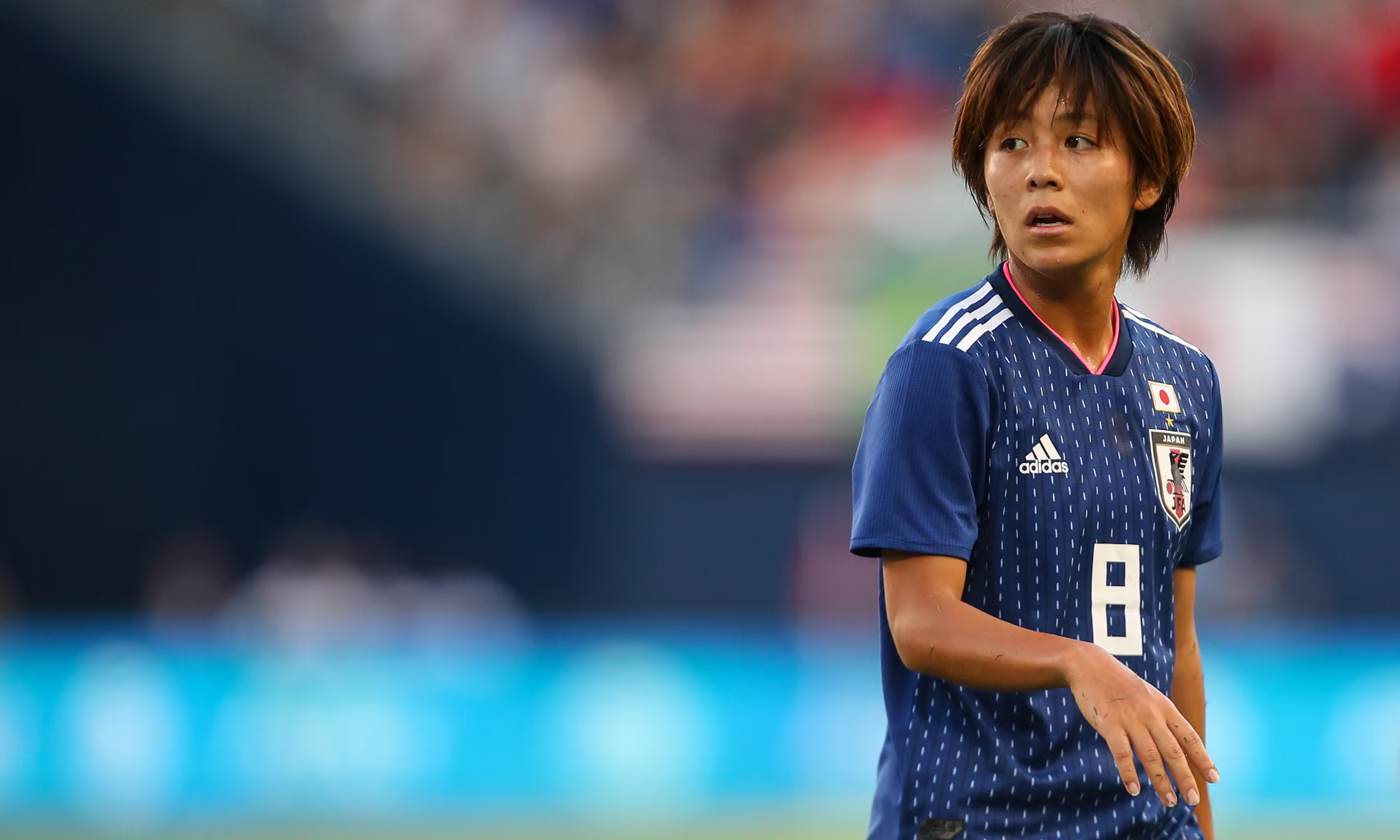
A key turning point came in 2002, when the JFA shifted its focus towards structured youth development, coaching education, and grassroots football. This strategic approach was designed to build an integrated system connecting academies, clubs, and the national team.
The results gradually began to show. By 2008, Japan had reached the semifinals of the Beijing Olympics. Three years later, the country achieved the greatest moment in Asian women’s football history.
The 2011 World Cup Breakthrough
Japan’s triumph at the 2011 FIFA Women’s World Cup in Germany transformed the status of women’s football in the country. Nadeshiko Japan defeated the United States in the final after a dramatic penalty shootout to become the first Asian team to win a senior FIFA title.
The victory carried enormous emotional significance, coming only months after the devastating 2011 earthquake and tsunami. The team’s resilience became a symbol of national hope and unity. Beyond the symbolism, the triumph validated Japan’s development model. It proved that technical training, tactical intelligence, and systemic planning could overcome physical disadvantages against stronger opponents.
Perhaps the biggest difference between Japan and India lies in their domestic league ecosystems. Japan took a revolutionary step in 2021 by launching the WE League (Women Empowerment League), the country’s first fully professional women’s football league.
Unlike many leagues worldwide, the WE League was designed with social and structural objectives:
- Clubs must have at least 15 fully professional players.
- Women must occupy leadership and management roles within clubs.
- There is no salary cap, allowing clubs to attract international players.
These policies ensure that players can focus entirely on football rather than balancing sport with part-time jobs — a common challenge in semi-professional leagues. The league has also built strong commercial partnerships and broadcasting visibility, including deals with major sponsors and digital platforms. Even though average attendances remain modest, certain high-profile matches attract crowds of more than 20,000 spectators, demonstrating growing public interest.
India’s Forgotten Golden Age
India’s women’s football story is very different. Interestingly, the country once held a stronger position in Asia than Japan. During the late 1970s and early 1980s, India was a major force in Asian women’s football. The national team finished runner-up in the AFC Women’s Asian Cup in 1979 and 1983, while also securing a third-place finish in 1981.

Players like Shanti Mullick, India’s first female footballer to win the Arjuna Award, helped establish the country’s reputation.
However, these successes were achieved in an era without proper infrastructure or professional systems. There was no national league, and most competitions were conducted at the state level. Without sustained investment or organisational planning, the early momentum faded.
Watch Indian Live Scores and Play Quiz – Download IndiaSportsHub App
The decline of Indian women’s football in the 1990s and early 2000s was severe. The most striking indicator came in 2009, when FIFA removed India from the world rankings because the team had not played an international match for more than 18 months.
During the same period, Japan was steadily building one of the most advanced women’s football ecosystems in the world.
India’s challenges were multifaceted:
- Lack of domestic competitions
- Limited financial support
- Social stigma surrounding women in sport
- Minimal media coverage
These factors created a development vacuum that continues to affect the national team today.
India’s first professional women’s competition, the Indian Women’s League (IWL), was launched only in 2016 nearly two decades after Japan began modernising its football structure. The league has gradually improved, introducing a home-and-away format and expanding participation. Clubs such as Gokulam Kerala FC, East Bengal, and Odisha FC have helped raise competitive standards.
However, the IWL still faces major challenges limited broadcast reach, short tournament windows & modest sponsorship revenue Average attendances remain extremely low, often below 300 spectators, highlighting the visibility gap between women’s football and the men’s game in India.
Watch Indian Live Scores and Play Quiz – Download IndiaSportsHub App
The structural difference between the two nations became evident during the 2026 AFC Women’s Asian Cup, when Japan defeated India 11–0.
Match statistics illustrated the gulf in performance where Japan controlled 78% possession, they produced 36 shots, including 18 on target while India failed to register a single shot during the match
Players like Hinata Miyazawa and Riko Ueki, who compete in top professional leagues abroad, showcased the level of technical and tactical development produced by Japan’s system. India, in contrast, relied largely on players developed within the domestic IWL ecosystem.
Recognising the need for structural reform, the All India Football Federation (AIFF) launched the ambitious Vision 2047 roadmap, aiming to transform Indian football by the centenary of the country’s independence.
Key targets for women’s football include:
- A multi-tier league pyramid by 2026
- Top-eight ranking in Asia by 2026
- Top-four Asian status by 2047
- Development of 20 major women’s clubs nationwide
The strategy also focuses heavily on grassroots development and talent identification. India has already established FIFA-supported talent academies, including a high-performance centre for girls in Hyderabad designed to nurture elite youth players.
Watch Indian Live Scores and Play Quiz – Download IndiaSportsHub App
Beyond infrastructure, the contrast between Japan and India also reflects societal attitudes toward women’s sport.
In Japan, the “Nadeshiko” identity has become a cultural symbol representing resilience, grace, and national pride. Women’s football enjoys recognition not only as a sport but as a vehicle for gender equality and social empowerment. In India, women’s football is still fighting for visibility in a sporting ecosystem dominated by men’s cricket.
However, recent developments including the commercial success of the Women’s Premier League (WPL) in cricket suggest that investment in women’s sport is gradually increasing.
Two Different Stages of the Journey
Japan’s challenge today is maintaining its position among the world’s elite while continuing to evolve its professional league. India’s challenge is far more fundamental: building the foundations of a sustainable ecosystem. The 11–0 defeat in Perth may have been painful, but it also served as a valuable benchmark. It highlighted the level India must aspire to reach.
Japan represents the blueprint of what consistent investment, strategic planning, and professional infrastructure can achieve.
For India, the journey toward that level has only just begun.


