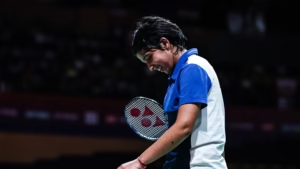
The Australian Open 2026 journey for Niki Kaliyanda Poonacha and Pruchya Isaro came to a close in the opening round, but the scoreline and circumstances tell a story far richer than a simple first-round exit.
The Indo-Thai pairing bowed out of the men’s doubles competition after a hard-fought straight-sets loss to the experienced Spanish duo of Pedro Martinez and Jaume Munar, going down 6–7 (3–7), 5–7 at Melbourne Park.
For Poonacha and Isaro, the defeat was narrow, competitive, and defined by fine margins rather than any gulf in quality. Both sets were pushed deep, both were balanced on a knife-edge, and in both, the Spanish pair showed greater composure in the decisive moments. The result ended what had been a rewarding pathway into the main draw, earned through their triumph at the Asia-Pacific Wildcard Playoffs in November, but it also underlined that the pair belong on this stage and are capable of competing against established ATP-level opposition.
The opening set set the tone for the contest. Neither pair was able to impose complete dominance on serve, but both held firm through long service games, resulting in a tightly contested battle that reached 5–5 without a break. Poonacha and Isaro showed clear intent, mixing aggressive first serves with proactive net play, while Martinez and Munar relied on consistency, depth, and calm decision-making from the baseline.
As the set moved into a tiebreak, the Spanish pair raised their level. Martinez and Munar were sharper on return and more disciplined in extended rallies, capitalising on a couple of loose points from the Indo-Thai combination. The tiebreak slipped away 7–3, leaving Poonacha and Isaro with the frustration of having stayed level for most of the set but without the reward to show for it.

The second set followed a similar pattern, reinforcing how evenly matched the contest was. Poonacha, now 30 and the more experienced of the two, led vocally and tactically, while Isaro brought energy and athleticism at the net. The pair served with intent and remained competitive on return, refusing to allow the Spanish duo to run away with the match.
At 5–5 in the second set, the contest again hung in the balance. This was the critical juncture where belief and execution mattered most. Martinez and Munar, both seasoned singles players with strong mental resilience, held their nerve. They absorbed pressure, extended rallies, and waited for opportunities rather than forcing the issue. When those chances came, they took them clinically, securing the decisive break before serving out the match 7–5.
From a statistical and tactical perspective, the match was decided less by dominance and more by situational awareness. Poonacha and Isaro were competitive on serve, matched their opponents for long stretches, and even edged certain service metrics. However, in doubles at the Grand Slam level, it is often the handful of points at 5–5 or in a tiebreak that define outcomes, and it was here that the Spanish pair proved more efficient.
Read Articles Without Ads On Your IndiaSportsHub App. Download Now And Stay Updated
Despite the loss, the context of this Australian Open appearance is important. Poonacha and Isaro were not direct entrants; they earned their place in the main draw by winning the Asia-Pacific Wildcard Playoffs, a demanding route that itself speaks to their quality and consistency across the region. That title was a significant achievement, particularly for Poonacha, who has been a steady presence in Asian tennis circuits and has gradually built his doubles credentials through years of persistence.
For Indian tennis, Poonacha’s presence in the Australian Open men’s doubles draw carried added significance. Opportunities for Indian players in men’s doubles at Grand Slams have become rarer in recent years, and every main-draw appearance matters. Partnering with Isaro, one of Thailand’s most promising doubles players, provided a balanced combination of experience and athleticism, and their performance in Melbourne showed that such cross-national pairings can be competitive at the highest level.
The match also highlighted the challenge of translating regional success into Grand Slam breakthroughs. The Asia-Pacific circuit is competitive, but the intensity, precision, and mental demands of a Slam first round are different. Facing players like Martinez and Munar, who are accustomed to the pressure of big arenas and long matches, requires not just skill but repeated exposure at this level.
For Isaro, the Australian Open debut experience will be invaluable. Playing in front of large crowds, dealing with the pace of the match, and understanding how small lapses can swing sets are lessons that only Grand Slam tennis can provide. For Poonacha, the campaign reinforces that he can still compete at this stage, even if the margins are unforgiving.
While the result will sting, this was far from a forgettable exit. The Indo-Thai pair pushed both sets to the edge, stayed competitive throughout, and showed flashes of the quality that earned them their wildcard entry in the first place. The difference lay not in effort or intent, but in execution during the most critical points.
Read Articles Without Ads On Your IndiaSportsHub App. Download Now And Stay Updated
As the Australian Open 2026 continues, Poonacha and Isaro will leave Melbourne with disappointment, but also with clarity. The gap to established Grand Slam-level doubles teams is narrow, and bridging it will require sharper decision-making under pressure and more exposure to matches of this intensity. Their campaign may have ended in round one, but the experience gained could prove crucial in shaping stronger performances in the months ahead.
For Indian tennis followers, this was a reminder that progress often comes in increments rather than leaps. A straight-sets loss can still be a competitive showing, and a first-round exit can still mark a step forward. The Australian Open chapter may be closed for now, but the lessons from Melbourne are likely to carry forward into the rest of the 2026 season.