

Indian sport today stands at a decisive crossroads. While medals, rankings and record-breaking performances dominate headlines, the real transformation is unfolding quietly beneath the surface in classrooms, playgrounds, coaching rooms and high-performance centers.
This was the central message of a powerful address delivered at the Jio Institute at 2nd Indian Sports Management Conference 2025, which outlined a systemic vision for Indian sport rooted not in short-term success, but in long-term sustainability and inclusion .
The address began by challenging a long-held perception. For decades, sport in India was viewed as a hobby something to be pursued after academics, not alongside it. That mindset is gradually shifting. Indian athletes are no longer global outliers who succeed despite the system; they are increasingly products of a structure that is beginning to nurture excellence by design rather than chance.
Yet, India’s sporting rise cannot be achieved in isolation. Talent exists everywhere in villages, towns and cities across the country. What remains scarce is access, opportunity and sustained support. To bridge this gap, the speech laid out five foundational pillars that together form a blueprint for ecosystem-driven sports development in India.
Democratizing access: sport as a right, not a privilege
The first pillar focuses on access. Every child, regardless of gender, geography, income, caste, disability or background, deserves a safe and supportive space to experience sport early in life. This belief underpins initiatives like Project Chhalaang , launched under the Dani Sports Foundation. The project advocates one hour of sport every day for every child, across all types of schools.
Read Articles Without Ads On Your IndiaSportsHub App. Download Now And Stay Updated
In just two years, Project Chhalaang has reached over 500,000 students across 2,300 schools in 23 districts. Flagship school programmes piloted in Pune have already impacted 10,000 children in 35 schools, with expansion underway. Partnerships with organisations like the Pratham Education Foundation have further extended the footprint to more than 540 schools and communities across multiple states.
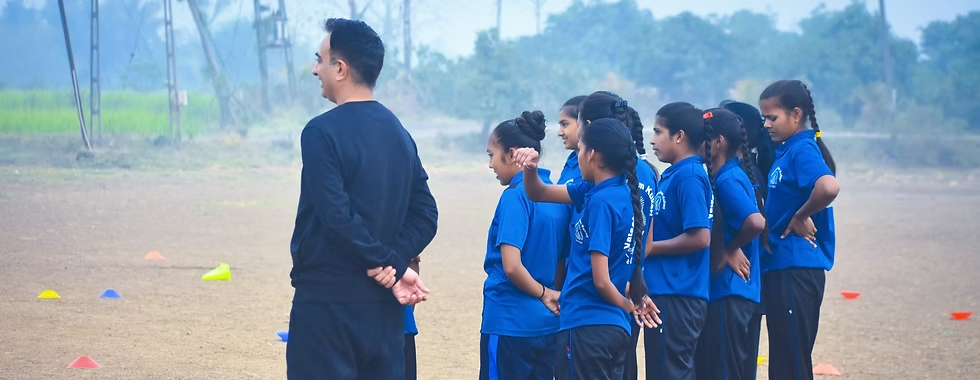
In total, over a million young lives have been positively influenced through sport-driven education and development programmes a scale that highlights what is possible when access is prioritized.
Empowering coaches: the invisible backbone of success
The second pillar recognizes the often-overlooked role of coaches. Behind every Olympic medal stands a coach whose work remains largely unseen. Through structured modules on physical literacy, child development and lesson planning, over 20,000 physical education teachers across India have been trained.
Beyond this, more than 3,000 educators outside traditional PT roles have been skilled to deliver inclusive sports programmes. International exposure has also been prioritized, with collaborations involving top universities in England to help Indian coaches align with global best practices.
The multiplier effect is significant: each trained coach goes on to shape hundreds of young athletes, reinforcing the grassroots foundation of Indian sport.
Smarter training through sports science and high performance
The third pillar shifts the conversation from effort to intelligence. Modern sport is not about training harder, but training smarter. Technology, data and sports science are now decisive factors in elite performance.

This philosophy is evident in partnerships with the Sports Authority of Gujarat and the Sports Authority of India at high-performance centers in Nadiad and the National Centre of Excellence in Rohtak. Across these centers, more than 600 athletes in 10 sports train within structured environments supported by data analytics, recovery systems and world-class coaching.
The outcomes speak for themselves. Medal tallies across programmes have risen from 65 in 2017 to over 300 by 2025. The Nadiad high-performance centre has also earned ISO 9001:2015 certification for quality systems a rare benchmark in Indian sport. These are not isolated successes, but proof that system-driven development delivers consistent results.
Read Articles Without Ads On Your IndiaSportsHub App. Download Now And Stay Updated
The fourth pillar underlines the power of collaboration. Sport cannot be transformed through isolated efforts; it requires government bodies, federations, private players and communities to work in unison.
A standout example is Indian table tennis. Through Ultimate Table Tennis (UTT), in partnership with the Table Tennis Federation of India and multiple corporate stakeholders, India achieved a historic milestone qualification of both men’s and women’s teams for the Paris 2024 Olympics. The women’s team narrowly missed a medal, but the achievement marked a breakthrough rather than a disappointment.
UTT has also invested in the future through initiatives like UTT Junior, where under-15 boys and girls were drafted into franchises and trained alongside elite international players. Similar partnership-driven models were highlighted in football, including collaborations with Norwich City that saw Indian under-12 players compete against European academies and even defeat Borussia Dortmund 4–2 a symbolic moment of belief.
Transforming mindsets: the hardest but most vital shift
The final pillar addresses the most complex challenge: mindset. Sport is not just about medals. It shapes identity, discipline, resilience, health and national pride. Real transformation occurs when communities treat sport as essential, parents celebrate effort over outcome, teachers view physical literacy as foundational, and institutions commit to long-term systems instead of short-term gains.
The speech concluded with a powerful reminder: the future of Indian sport will not be written in boardrooms or policy documents, but on playgrounds and training fields. If India continues to build systems where talent meets opportunity and effort meets support, the country will not merely participate on the world stage it will help define it.
From grassroots fields to global arenas, the journey has begun.
The challenge now is to ensure it does not stop.


