In the long and evolving journey of Indian badminton on the international stage, there have been landmark victories that have quietly shifted belief systems within the sport. One such achievement came in 2014, when Arvind Bhat became the only Indian to win the German Open men’s singles title a feat that remains unmatched more than a decade later.
What made this triumph particularly significant was not just the title itself, but the context in which it was achieved.
At 35 years of age, unseeded and ranked 87th in the world at the time, Bhat entered the prestigious BWF Grand Prix Gold event in Mülheim an der Ruhr as an outsider. In a sport where peak performance is often associated with players in their early to mid-twenties, his victory stood as a rare example of longevity intersecting with tactical excellence.
Held between February 25 and March 2, 2014, the German Open attracted a competitive international field preparing for the All England Championships. The tournament, staged at the RWE-Sporthalle, carried a prize purse of USD 120,000 and was among the most prominent stops on the BWF Grand Prix Gold circuit at the time. Bhat’s presence in the draw did not initially attract much attention, but that would change rapidly over the course of the week.
Watch Indian Live Scores and Play Quiz – Download IndiaSportsHub App
His campaign began with a straightforward win over Germany’s Ari Trisnanto, allowing him to adapt to the hall conditions without expending excessive energy. However, the defining moment of his tournament arrived in the second round, where he faced third seed Hu Yun of Hong Kong, ranked 13th in the world. In a three-game contest, Bhat secured a 21-17, 16-21, 21-11 victory the first major upset of the tournament and a clear indication that he was capable of challenging higher-ranked opponents.
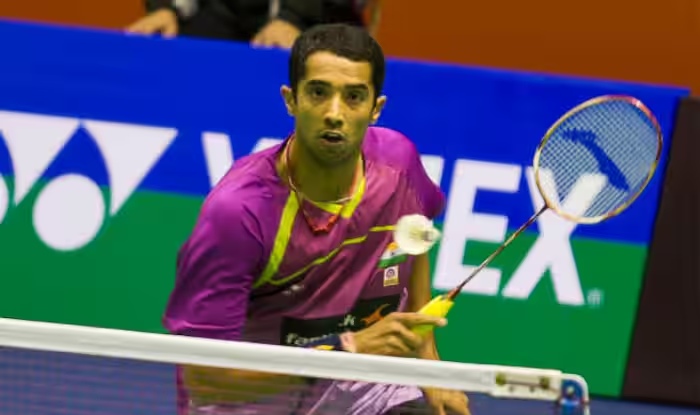
The third round saw him overcome Malaysia’s Daren Liew, ranked 34th globally, before facing a young Viktor Axelsen in the quarterfinals. At the time, Axelsen was already the reigning World Junior Champion and ranked 14th in the world. Bhat delivered one of the standout performances of the event, defeating the Dane 21-17, 21-14 in just 35 minutes to progress to the semifinals.
In the semifinals, he encountered Chou Tien Chen of Chinese Taipei, then ranked 24th in the world. After losing the opening game 12-21, Bhat responded with composure to take the next two games 21-12, 22-20 in a 55-minute encounter that tested both players’ endurance. The victory set up a final against Denmark’s Hans-Kristian Vittinghus, the 12th seed and world No. 25.
The championship match turned into a battle of attrition. Bhat trailed 18-20 in the opening game but saved four game points to take it 24-22. Although Vittinghus claimed the second game 21-19 after Bhat had led 17-12, the Indian regained control in the decider. Recognising his opponent’s restricted movement due to a back issue, Bhat accelerated the pace and variety of his attacks, eventually winning the third game 21-11 to clinch the title.
Watch Indian Live Scores and Play Quiz – Download IndiaSportsHub App
With that result, Bhat became the first Indian to win the German Open since its inception in 1955. The victory also marked his only BWF Grand Prix Gold title — a crowning achievement in an international career that began in 2002 after he completed his mechanical engineering degree from the University Visvesvaraya College of Engineering in Bengaluru.
Bhat’s journey into professional badminton differed from many of his contemporaries. Unlike players who transitioned into full-time training during their teenage years, he completed his academic education before joining the Indian national setup. This delayed professionalisation meant that his international peak arrived later than most, culminating in the German Open title at an age when many athletes begin contemplating retirement.
His success in Mülheim was also aided by years of experience competing in the German Bundesliga, representing 1. BC Bischmisheim. Spending several months annually in Europe provided familiarity with playing conditions and styles of European opponents an advantage that was evident throughout his tournament run.
Structurally, the landscape of international badminton has changed since 2014, with the BWF Grand Prix Gold circuit replaced by the World Tour system in 2018. Today, the German Open is classified as a Super 300 event, carrying comparable ranking points but greater prize money. Yet, despite these developments, no Indian has managed to replicate Bhat’s success at the tournament.
In retrospect, Arvind Bhat’s victory remains a defining example of how experience, tactical discipline and physical management can overcome ranking disparities and generational gaps. It also represented a bridging phase in Indian men’s singles badminton between the era of Pullela Gopichand and the emergence of players like Kidambi Srikanth and Lakshya Sen.
More than a decade on, the 2014 German Open title continues to stand as a reminder that elite performance in badminton is not solely determined by age or seeding, but by adaptability and execution at the highest level.