
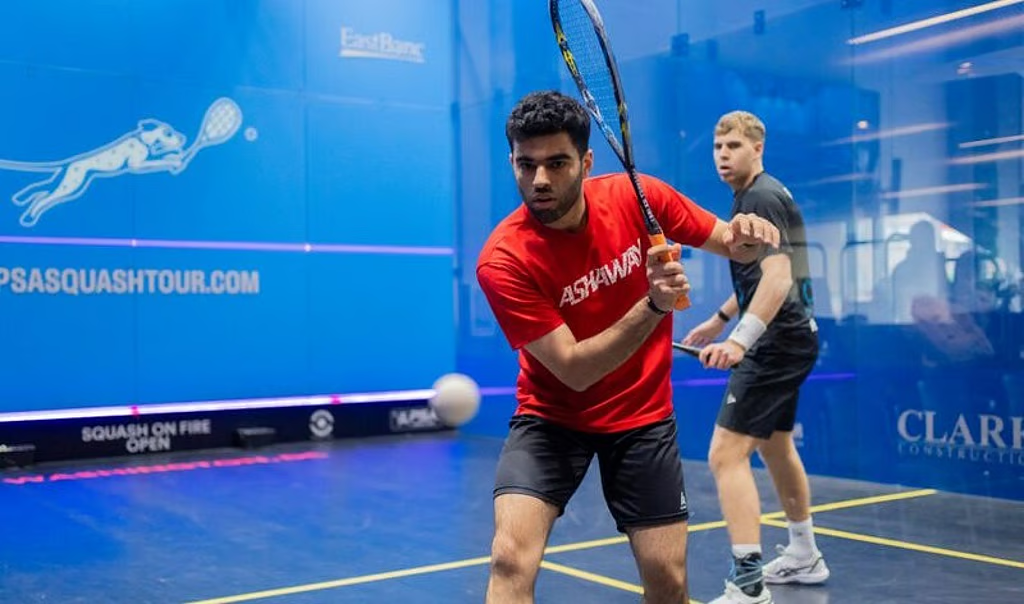
On a pleasant evening at Mumbai’s Cricket Club of India, Veer Chotrani walked off court with quiet satisfaction.
It wasn’t just another win it was a step into the semifinals of the JSW Indian Open 2026, a tournament that represents both familiarity and aspiration for one of India’s most promising squash professionals.
“I’m very happy to get through,” he said after the match, reflecting on the unexpected crowd support during an off-peak session. “And I’m excited to play on the glass court.”
For Chotrani, that glass court is more than a stage it is symbolic of a career that has steadily moved from the margins of junior promise to the spotlight of elite global competition.
A Legacy Rooted in Squash
Veer’s journey into squash was never incidental. Born into a family deeply embedded in the sport, his earliest exposure came through his father, Manish Chotrani, a former national champion. Squash courts were not foreign environments they were, in many ways, his playground.
“I’ve been around the squash court since the day I was born,” Veer noted.
This early immersion created an intuitive understanding of the sport. By the time he entered competitive circuits, his game already reflected advanced ball control and tactical awareness traits that would later become his defining strengths. His rise through the junior ranks was equally telling. Winning the Asian Junior U19 Championship in 2019 placed him in an elite bracket of Indian players and validated his potential on the continental stage.
But talent alone was never going to be enough.
Watch Exciting Prizes by Playing Sports Quiz – Download IndiaSportsHub App
If Mumbai built the foundation, Cornell University shaped the athlete. Veer’s move to the United States in 2019 marked a strategic shift. The American collegiate system offered something Indian squash lacked a structured, high-performance ecosystem that combined academics with elite sport.
Under the guidance of former world number one David Palmer, Veer underwent a transformation that would redefine his career.
“I was a very skillful player but I wasn’t the most physically fit,” he admitted. “David was the perfect fit for me.”
The results were significant. Over five years, Veer became the most decorated player in Cornell’s history, culminating in an unbeaten 16–0 season and a national collegiate title in 2024. More importantly, he developed the physical endurance and mental resilience required for professional squash a sport where matches can extend beyond 90 minutes at relentless intensity.

What makes Veer Chotrani’s journey unique is his ability to seamlessly integrate two very different developmental systems.
On one hand, he carries the instinctive, skill-driven approach of Indian squash. On the other, he embodies the discipline and physicality honed through American collegiate training. This hybrid model has positioned him as part of a new generation redefining Indian squash.
Currently ranked inside the top 50 globally, Veer represents a shift from isolated excellence to collective strength. Alongside players like Abhay Singh, Ramit Tandon, and Velavan Senthilkumar, India now boasts a competitive core capable of challenging the world’s best.
“We have four guys who can beat each other on any given day,” Veer said. “That’s great for Indian squash.”
The Egyptian Benchmark
In modern squash, Egypt remains the gold standard. Their dominance is not just technical it is cultural. Veer offers a clear-eyed assessment of this gap.
“In Egypt, you have 1000 kids playing in each age group and they grow up watching world number ones train next to them,” he explained.
This ecosystem creates a pipeline of excellence that India is still striving to replicate. Yet, the gap is narrowing. Increased government funding, improved infrastructure, and a growing professional circuit have begun to reshape the landscape.
For Veer and his contemporaries, this represents both an opportunity and a responsibility.
Transitioning from collegiate success to the PSA World Tour is often the most difficult phase in a squash player’s career. The level of competition rises sharply, and consistency becomes the defining metric. Veer’s professional journey reflects a methodical climb. Since joining the PSA circuit, he has steadily built his ranking through Challenger and Tour-level events, securing multiple titles and registering wins over top-20 players.
But what stands out is not just the victories it is his ability to compete.
“I always knew I had the game,” he said. “But staying mentally and physically strong for 90 minutes that’s what I’m improving.”
That evolution is evident in his performances. Whether pushing top-ranked opponents to five games or maintaining consistency across tournaments, Veer is transitioning from a challenger to a contender.
The Indian Core
One of the most significant developments in Indian squash is the emergence of a strong, interconnected player group. Unlike previous eras, where a single player dominated, the current generation thrives on internal competition.
Veer, Ramit Tandon, and Velavan Senthilkumar train together under David Palmer, creating a shared ecosystem of learning and rivalry.
“It’s a healthy rivalry. We’re friendswe spend more time with each other than with our families,” Veer remarked.
This collective growth is crucial, especially with major events on the horizon.
Watch Exciting Prizes by Playing Sports Quiz – Download IndiaSportsHub App
The inclusion of squash in the Los Angeles 2028 Olympics has fundamentally altered the sport’s trajectory. For players like Veer, it provides a clear, tangible goal.
“This year is very important,” he said, referring to the Asian Games qualification pathway. “Whoever wins makes it to the Olympics.”
The stakes are immense. The Asian Games now serve as a gateway, intensifying competition within Asia while raising performance standards. For India, which already has one of the strongest teams on the continent, the opportunity is unprecedented.
“I think we are the best team in Asia right now,” Veer stated. It is a bold claim but not an unrealistic one.
At 24, Veer Chotrani is entering a critical phase of his career. The foundations are firmly in place technical skill, physical conditioning, and international exposure. The next step is consolidation.
Breaking into the top 30, consistently reaching the latter stages of major tournaments, and delivering at multi-sport events like the Asian Games will define his trajectory over the next two years. Equally important will be his ability to sustain performance levels against the world’s elite a challenge that demands not just skill, but relentless discipline.
What makes Veer’s story compelling is not just his rise in rankings, but what he represents.
He is part of a generation that has benefited from better systems, global exposure, and structured development pathways. But he is also a product of legacy of a father’s influence, of early exposure, and of a deep-rooted connection to the sport.
In many ways, Veer Chotrani is the bridge between Indian squash’s past and its future. As he prepares to step onto the glass court for another high-stakes match, Veer carries more than just personal ambition. He carries the expectations of a sport on the rise.
Indian squash is no longer defined by isolated brilliance. It is evolving into a collective force, capable of challenging traditional powerhouses. And at the center of this transformation stands Veer Chotrani composed, evolving, and ready for the next level. The semifinal in Mumbai may be just another match. But in the larger narrative of his career, it is another signal.
India’s next global squash contender is no longer emerging.
He has arrived.


