Indian wrestling has taken a decisive step toward the Los Angeles 2028 Olympic cycle with the Wrestling Federation of India (WFI) finalising a new set of foreign coaches across all three disciplines men’s freestyle, women’s wrestling, and Greco-Roman.
The appointments, subject to final approval from the Sports Authority of India (SAI), underline a clear shift toward structured, performance-driven preparation aimed at restoring India’s competitive edge on the global stage.
The coaching panel features Georgian Shako Bentinidis for men’s freestyle, American Ian Butler for women’s wrestling, and Iranian Saeid Abbaszadeh for Greco-Roman. While the trio brings diverse technical backgrounds, the larger narrative lies in how WFI is attempting to rebuild its system both on and off the mat after a period of inconsistency and transition.
A Strategic Blend of Global Expertise
The composition of the coaching panel reflects a deliberate attempt to integrate varied wrestling philosophies. Bentinidis, who previously worked closely with Olympic medallist Bajrang Punia, returns to Indian wrestling in a broader national role. Known for his emphasis on defensive solidity, endurance, and tactical awareness, his appointment suggests a renewed focus on building consistency within the men’s freestyle setup.
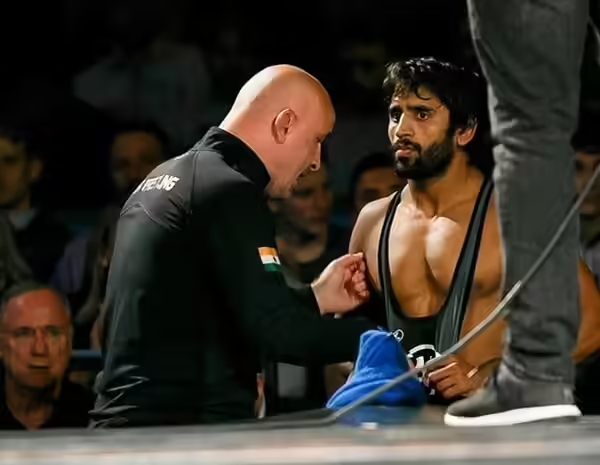
At a reported salary of $3,000 per month, his re-engagement also indicates a move toward cost-controlled yet targeted investment. More importantly, it signals WFI’s belief in familiarity bringing back a coach who understands the Indian system and has previously delivered results.
In contrast, the appointment of Ian Butler as the women’s wrestling coach represents a more progressive shift. With a background rooted in American wrestling systems, MMA, and Brazilian Jiu-Jitsu, Butler brings a hybrid approach that focuses on explosiveness, transitions, and aggressive hand-fighting.
His significantly higher salary of $8,000 per month reflects the federation’s prioritisation of women’s wrestling, a category where India has consistently shown medal potential. The expectation is clear—modernise techniques, improve finishing ability, and bridge the gap with dominant nations like Japan and the United States.
Watch Indian Live Scores and Play Quiz – Download IndiaSportsHub App
Completing the trio is Saeid Abbaszadeh, tasked with revitalising India’s Greco-Roman program. Traditionally the weakest of the three disciplines for India, Greco-Roman wrestling has struggled for consistent international success. Abbaszadeh, with over 15 years of coaching experience across Asia and the Middle East, brings the technical depth associated with Iran’s globally respected wrestling system. His focus will be on fundamentals upper-body control, positioning, and pummelling techniques.
Beyond Coaching: A Systemic Overhaul
While the coaching appointments are significant, they are part of a broader structural reset within Indian wrestling. WFI has simultaneously introduced a new selection framework that prioritises current form over past achievements, marking a departure from previous cycles where elite wrestlers often enjoyed automatic selection.
Under the new policy, even athletes who secure Olympic quotas will have to compete in selection trials. This ensures accountability and maintains competitive intensity within the system.
Additionally, participation in national camps has been made mandatory. Wrestlers who fail to attend camps risk losing eligibility for trials, regardless of their past credentials. This move aims to centralise training, improve monitoring, and ensure that all athletes are aligned with the national coaching philosophy.
The urgency behind these reforms was evident during the 2026 Asian Championships trials, where several high-profile upsets highlighted the unpredictability of the domestic circuit. The most notable result was the defeat of Antim Panghal, a two-time World Championships medallist, by Meenakshi in the 53kg category.
Such results reinforced the need for a merit-based system. The message from WFI is clear reputation alone will not guarantee selection. Performance, consistency, and discipline will be the defining criteria moving forward.
The financial structure of the coaching appointments also reflects a more pragmatic approach. While Butler’s salary stands out, the relatively modest packages for Bentinidis and Abbaszadeh suggest that WFI is balancing investment with sustainability.
Negotiations with other high-profile coaches reportedly fell through due to salary demands exceeding budgetary limits, highlighting the federation’s intent to operate within defined financial parameters. This controlled spending approach is likely influenced by broader administrative reforms and the need for greater accountability.
Technical Impact on Indian Wrestling
From a technical standpoint, the integration of three distinct wrestling philosophies presents both an opportunity and a challenge.
- Men’s freestyle is expected to benefit from improved defensive structure and stamina under Bentinidis.
- Women’s wrestling could see a shift toward a more aggressive, attack-oriented style under Butler.
- Greco-Roman will likely undergo foundational rebuilding, focusing on technique and positional discipline under Abbaszadeh.
The key will be integration ensuring that these approaches complement rather than conflict with each other and with India’s traditional wrestling base.
Despite the optimism, several challenges remain. Coordination between WFI and SAI will be critical to ensure timely onboarding of coaches and smooth implementation of training programs. There is also the question of athlete adaptation. The shift toward centralised camps and stricter selection criteria may face resistance from established wrestlers accustomed to more flexible systems.
Moreover, aligning domestic training structures with international standards will require sustained effort, particularly in areas such as sports science, nutrition, and injury management.
The finalisation of the foreign coaching panel marks the beginning of a new phase for Indian wrestling. With the Asian Games 2026 and subsequent Olympic qualification events on the horizon, the focus will be on building momentum and consistency. For a sport that has historically been one of India’s strongest at the Olympics, the expectations remain high. The challenge now is to convert structural changes into tangible results.
If executed effectively, this new framework—combining international expertise with a disciplined domestic system could redefine Indian wrestling’s trajectory over the next Olympic cycle.
The blueprint is in place. The real test begins on the mat.