
The Indian government’s continued commitment to elite sport was underlined this week as the Ministry of Youth Affairs and Sports approved ₹11.80 lakh for Neeraj Chopra’s overseas training program, reinforcing a highly individualized approach to preparing India’s biggest Olympic star for a demanding 2026 season.
The funding, cleared through the Mission Olympic Cell (MOC) under the Target Olympic Podium Scheme (TOPS), is aimed at sharpening Chopra’s preparation ahead of the Asian Games in Nagoya and the Commonwealth Games in Glasgow later this year .
The sanctioned amount will cover Chopra’s 32-day high-performance training camp in Potchefstroom, South Africa, a venue that has become synonymous with his Olympic success. Potchefstroom, home to world-class athletics facilities at North-West University, has previously hosted Chopra’s pre-Olympic training blocks ahead of both Tokyo 2020 and Paris 2024, making it a familiar and trusted base for rebuilding strength, rhythm, and technical consistency.
Read Articles Without Ads On Your IndiaSportsHub App. Download Now And Stay Updated
Unlike blanket funding models of the past, the ₹11.80 lakh allocation reflects India’s shift towards precision funding, where every rupee is tied to a specific performance outcome. The grant is designed to cover training facility access, local transport, accommodation, out-of-pocket allowances, and the costs associated with maintaining Chopra’s immediate support staff, including coaching and physiotherapy.
This assistance is over and above the annual training and competition budgets allocated to the Athletics Federation of India (AFI), highlighting how elite athletes in the TOPS core group receive customized interventions tailored to their competitive calendars and physical needs.
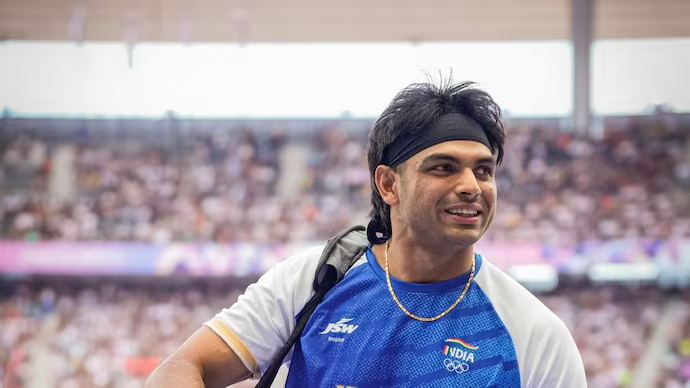
The decision was taken during the 167th meeting of the Mission Olympic Cell, which approved multiple athlete proposals across disciplines, reaffirming the MOC’s role as a fast-track decision-making body capable of responding to elite athletes’ evolving requirements .
Managing a Critical Phase in Chopra’s Career
For Neeraj Chopra, the 2026 season represents a crucial transition phase. While his legacy is already secure with two Olympic medals, the immediate challenge lies in managing physical durability while remaining competitive at the highest level. The 2025 season, though highlighted by Chopra finally breaching the 90-meter barrier, was also disrupted by back and adductor issues, culminating in an uncharacteristic eighth-place finish at the World Athletics Championships.
As a result, the current South African training block has been framed primarily around rehabilitation, controlled loading, and technical recalibration, rather than early-season competition peaks. The Sports Authority of India has described the camp’s objective as sharpening “physical conditioning, strength, and technical consistency” while ensuring that lingering injury concerns are addressed well ahead of major championships.
Read Articles Without Ads On Your IndiaSportsHub App. Download Now And Stay Updated
One of the most significant aspects of Chopra’s 2026 preparation is his return to long-time coach Jai Chaudhary, marking a shift from the short but high-intensity stint under Czech legend Jan Železný. While Železný’s influence helped Chopra unlock new technical cues, most notably the historic 90.23 m throw in Doha the physical demands of that phase coincided with injury challenges.
The reunion with Jai Chaudhary, who guided Chopra during his formative years in Panipat, is seen as a move towards technical stability and biomechanical familiarity. Chaudhary’s deep understanding of Chopra’s baseline mechanics is expected to play a key role during this recovery-focused period, particularly in managing training volumes and preventing overload.
Asian and Commonwealth Games in Focus
The timing of the funding approval is significant. The Commonwealth Games in Glasgow (July–August 2026) and the Asian Games in Nagoya (September–October 2026) are the primary peak targets of the year. Both events carry enormous strategic value: the Commonwealth Games as a chance to reassert dominance in a familiar multi-sport environment, and the Asian Games as a highly competitive continental test against rising regional rivals.
Given the congested global calendar and the physical demands of javelin throwing, Chopra’s participation in the Diamond League circuit is expected to be selective, with competitions chosen carefully to balance match sharpness and recovery.
Chopra’s funding approval also sits within a larger ecosystem of investment in Indian athletics. The MOC has simultaneously sanctioned funds for equipment and infrastructure upgrades for emerging javelin throwers, signalling a conscious effort to build depth beyond a single superstar. This approach reduces long-term dependence on one athlete while ensuring internal competition remains strong.
At a policy level, such targeted support has been made possible by a steadily increasing sports budget and a more agile administrative framework that prioritises performance outcomes over procedural rigidity.
Precision, Patience, and Long-Term Thinking
The ₹11.80 lakh sanction is modest in absolute terms but significant in intent. It reflects a system that understands elite sport as a long-term, athlete-centric process, where recovery is valued as much as competition and where preparation is shaped around the individual rather than the calendar.
As Neeraj Chopra builds towards another demanding season, the focus is clear: protect the body, refine the technique, and arrive at the Asian and Commonwealth Games in peak condition. In that context, this approval is less about expenditure and more about trust in a proven champion, backed by a system that has learned how to support excellence at the highest level.


