

Indian football stands at a rare crossroads. For the first time in its modern history, four national teams Senior Women, U-20 Women, U-17 Men, and U-17 Women have simultaneously qualified for their respective AFC Asian Cup finals, each serving as a direct qualification gateway to a FIFA World Cup.
The year 2026, therefore, presents an unprecedented, multi-tiered opportunity that could redefine India’s global football footprint in a way no single cycle has before.
This moment arrives in contrast to the more familiar disappointment on the men’s side. The senior men’s run for the expanded 2026 FIFA World Cup ended in June 2025, after they finished third in Group A behind Qatar and Kuwait in the second round of Asian qualifiers. A narrow but decisive 2–1 defeat to Asian champions Qatar in their final match confirmed India’s elimination. For the AIFF, that defeat closed one chapter but inadvertently sharpened the focus on a broader strategic truth: India’s most realistic World Cup pathways at least for this cycle lie not with the men, but with the women’s and youth teams.
The Shift in Global Football that Favors India
The expansion of FIFA competitions has altered the calculus. The AFC now holds eight direct slots for the men’s 2026 World Cup, six direct slots for the 2027 Women’s World Cup, and increased quotas across all youth competitions. For nations like India still developing at the senior levels but rising quickly in women’s football and youth structures this expansion opens doors that once seemed unreachable. The attached data outlines this new strategic landscape clearly: India’s route to 2026–27 World Cups flows through the continent-first, world-later qualification logic that underpins modern AFC tournaments.
Senior Women: Navigating a Heavyweight Group Toward Brazil 2027
India’s senior women enter the 2026 AFC Women’s Asian Cup in Australia knowing exactly what’s at stake. The tournament doubles as the qualifying competition for the 2027 FIFA Women’s World Cup in Brazil, offering six direct Asian berths and two playoff opportunities. It is, in many ways, India’s most direct and structurally favorable pathway.
Read Articles Without Ads On Your IndiaSportsHub App. Download Now And Stay Updated
But the challenge begins immediately in Group C, where India face Japan, Vietnam, and Chinese Taipei. Japan, ranked seventh in the world and a former World Cup champion, represent one of the toughest opponents possible. Vietnam, now an established Southeast Asian force, add another layer of competition. Chinese Taipei, meanwhile, stand as India’s most realistic opportunity to earn critical group-stage points.
The format, however, gives India a fighting chance. With 12 teams split into three groups, the two best third-placed teams also reach the quarter-finals. This “best thirds” route is the clearest strategic entry point for India, who will likely need a result against Chinese Taipei and disciplined defensive showings against Japan and Vietnam to progress.
Reaching the quarter-finals (Top 8) is only the beginning. Losing quarter-finalists enter a secondary playoff, where the winners secure Asia’s remaining two direct World Cup slots (finishing in the Top 6), while the losers advance to the global inter-confederation playoffs.
In short: India must think tournament-first, not match-first. Survive the group, reach the quarter-finals, then win one direct playoff. The path is steep, but far from impossible.
U-20 Women: A 20-Year Return, A Brutal Group, A Single Must-Win Match
The U-20 Women’s Asian Cup 2026 in Thailand marks India’s first appearance in the tournament since 2006. That gap underlines the significance of their qualification achieved through a gritty 1–0 win over hosts Myanmar in the final round. Little separates history from opportunity here: the AFC receives just four slots for the 2026 U-20 Women’s World Cup in Poland, meaning only the semi-finalists qualify.

But India’s group Japan, Australia, and Chinese Taipei is one of the tournament’s strongest. Japan and Australia are perennial continental heavyweights, while Chinese Taipei present the decisive matchup India must target. Most realistic scenarios have India aiming for qualification as one of the best third-placed teams. That would set up a quarter-final against a top-tier opponent a single elimination match that could send India to a World Cup. Everything rests on that moment.
U-17 Men: The Most Attainable Target
The U-17 men’s team arguably holds the most achievable path. After a remarkable 2–1 comeback win over Iran in the qualifiers, India booked their tenth Asian Cup appearance. With Qatar already qualified as hosts of the 2026 FIFA U-17 World Cup, the AFC receives nine total slots meaning the top eight teams from the Asian Cup (i.e., the quarter-finalists) qualify.
India’s Grit and Glory: A Stunning Qualification for the AFC U17 Asian Cup
India have reached this stage twice before (2002, 2018). The current squad has shown resilience, tactical maturity, and the ability to deliver in must-win moments. Their objective is clear: navigate the group stage and reach the quarter-finals. Unlike the women’s teams, they do not need to win the quarter-final only reach it.
U-17 Women: A Breakthrough Generational Moment
Perhaps the most heartening story lies with the U-17 women, who earned their place at the 2026 Asian Cup through qualification rather than hosting. Their comeback win over Uzbekistan underscored both character and progress. To qualify for the 2026 U-17 Women’s World Cup in Morocco, they must finish in the top four meaning another quarter-final must be won. Like the U-20s, this tournament will likely hinge on a single knockout match against one of Asia’s elite.
Read Articles Without Ads On Your IndiaSportsHub App. Download Now And Stay Updated
Across all pathways, one truth stands out: India’s World Cup dreams in 2026 will be decided in four quarter-finals. Each team’s structure, resources, and preparation must now be oriented toward that exact scenario 90 minutes that could redefine Indian football’s global trajectory.
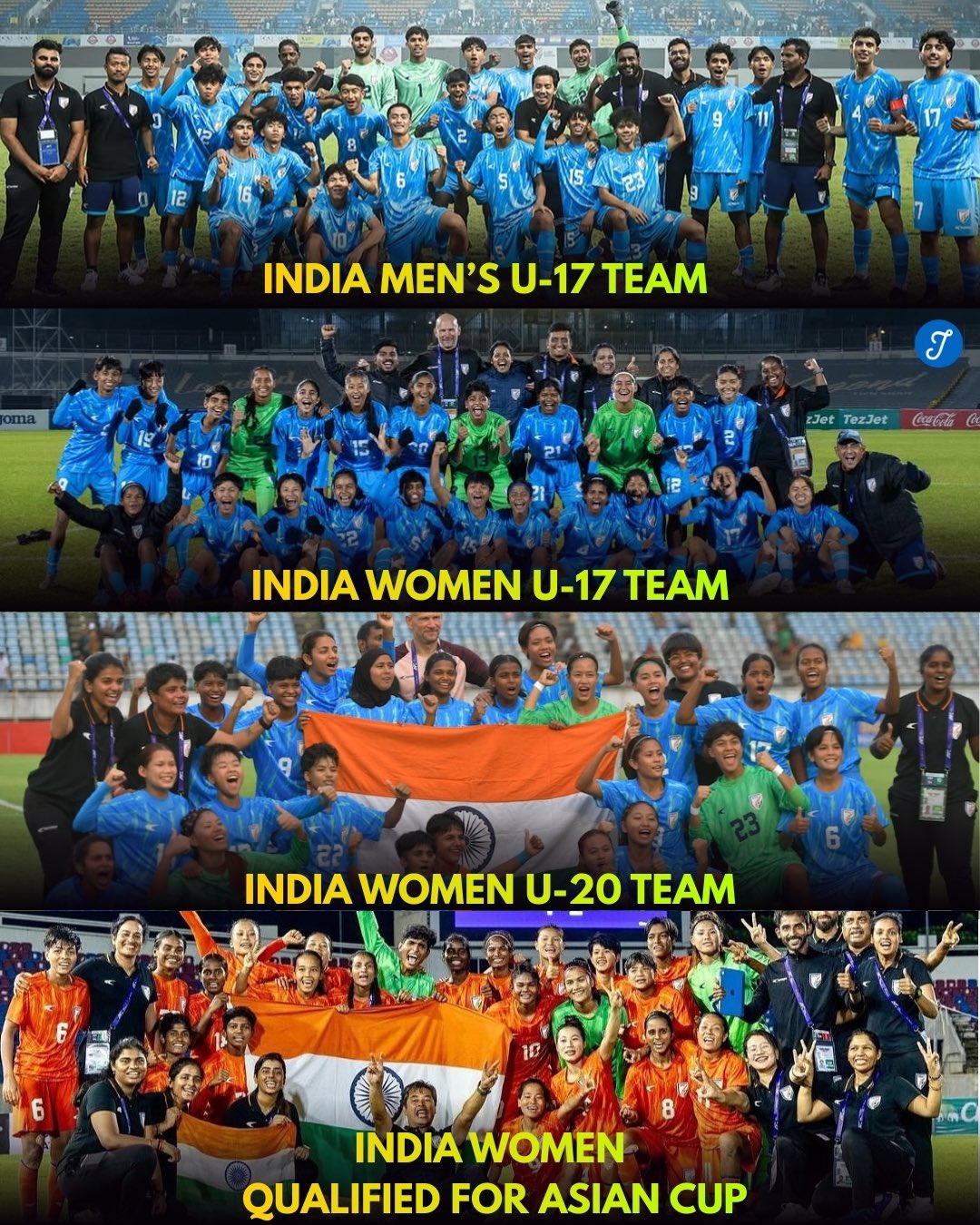
If even one team succeeds, 2026 will be remembered as a transformative year.
If more do, it could mark the beginning of a new era.


