

In one of the most ambitious institutional reforms in recent Indian sporting history, the Ministry of Youth Affairs and Sports has approved the recruitment of 320 Assistant Coach across 25 disciplines under the Sports Authority of India (SAI).
This massive expansion part of a two-phase plan that will ultimately appoint 640 new coaches marks the largest investment in India’s coaching workforce since 2017 and signals a decisive shift in the country’s high-performance roadmap. More than a hiring exercise, it represents a structural redesign of India’s talent-development architecture.
At its heart, the initiative addresses two long-standing gaps in Indian sport: the need for a professional, stable coaching cadre and the urgent requirement to correct the severe gender imbalance within the system. By designating these posts as permanent (Level-06 under the 7th CPC), the Ministry is ensuring job security, retention of domestic expertise, and institutional continuity crucial components for sustained Olympic preparation.
Read Articles Without Ads On Your IndiaSportsHub App. Download Now And Stay Updated
For years, India’s high-performance system has struggled with inconsistent coaching power. A heavy reliance on contractual staff created instability, frequent turnover, and limited long-term planning. The new recruitment phase directly tackles these weaknesses.
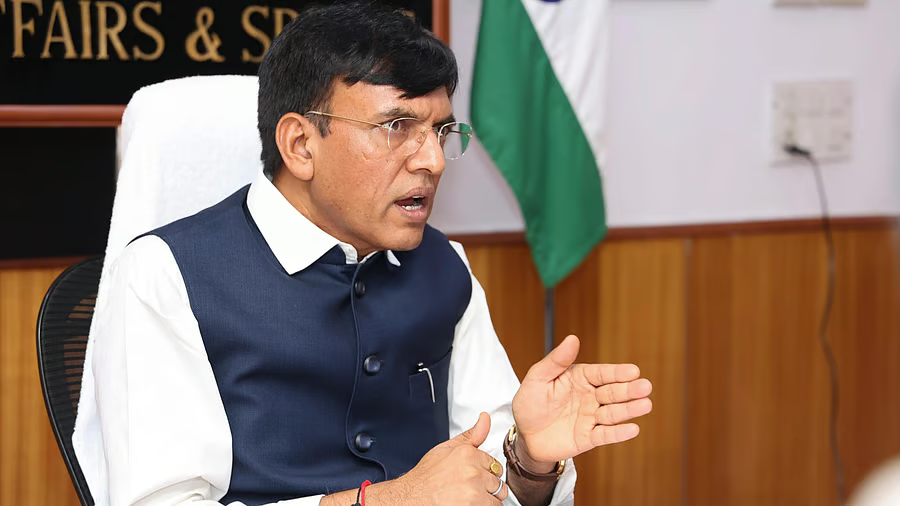
Assistant Coaches, as the Sports Minister describes them, are the “important cog in the wheel” the first point of contact for young athletes and the key drivers of technical development. They work at the foundation of the Long-Term Athlete Development (LTAD) model, ensuring talent is identified early, trained correctly, and prepared to graduate into elite programs such as the Target Olympic Podium Scheme (TOPS).
Strengthening this layer is not merely administrative. It is strategic. Poor technical fundamentals at the grassroots level often spiral into expensive course corrections later. Investing early saves both time and resources and raises India’s overall talent-conversion rate.
Targeting India’s Weak Spots: Aquatics, Cycling, Kayaking
This coaching expansion is not uniform; it is deliberately weighted toward disciplines where India has historically underperformed but where medal opportunities are vast. Aquatics, Cycling, and Tennis were cited explicitly by the Minister, alongside renewed emphasis on Kayaking and Canoeing. This approach is rooted in a clear “medal basket diversification” strategy. India’s historical Olympic tally largely dependent on hockey for decades shows how dangerously reliant the country has been on a handful of sports. To become a genuine global sporting power, India must spread its competitive profile across high-volume disciplines.
Aquatics, for example, offers dozens of events across strokes and distances. Even incremental growth can produce multiple finalists and long-term medal prospects. Cycling requires deep technical knowledge, biomechanics, and modern track-specific training—areas India has yet to master.
And Kayaking/Canoeing, despite minimal historical investment, recently produced a bronze at the 2023 Asian Games, signaling a discipline where rapid progression is possible with the right coaching support. By deploying specialist Assistant Coaches in these areas, the Ministry is investing in sports with both a high number of medal events and untapped development potential.
A Game-Changing Governance Commitment: 50% Posts Reserved for Women
Among all structural changes, the most transformative is the mandatory 50% reservation for women coaches. This is not symbolic it is functional, necessary, and overdue.
Read Articles Without Ads On Your IndiaSportsHub App. Download Now And Stay Updated
Currently, only 16.09% of SAI’s coaching workforce is made up of women. This creates operational and welfare challenges, especially since SAI mandates that female athletes must be accompanied by a woman coach during camps, travel, and exposure tours. With so few women on staff, compliance has been inconsistent.
By ensuring that at least 160 of the 320 new recruits are women, the system takes a massive step toward addressing athlete safety, gender representation, and structural balance. It also strengthens SAI’s Safe Sports Policy by ensuring more women occupy supervisory and leadership roles in daily training environments. However, this quota introduces a sourcing challenge: many niche sports such as Kayaking, Cycling, Rowing, Fencing, Wushu have very few certified women coaches. Since all recruits must be certified or licensed, the Ministry must simultaneously expand certification pathways to avoid vacancies or diluted standards. It is a complex balancing act quantity versus capability but one that is essential for long-term change.
Ensuring Transparency, Quality, and Long-Term Impact
The Ministry has emphasised that recruitment will be completely merit-based and transparent, accepting only certified candidates and publishing clear evaluation norms. But hiring is only the first step. With 320 new staff entering the system simultaneously, SAI’s academic arm, the National Institute of Sports (NS NIS), must rapidly scale induction training, orientation, and continuous professional development programs. These must include:
- LTAD methodology
- technical and biomechanics modules
- Safe Sport and gender-sensitivity training
- grievance-redressal education
- performance reporting frameworks
Given the size of this intake, the NS NIS curriculum must be updated to global standards, ensuring the new cadre can coach modern athletes preparing for Paris, Los Angeles, and beyond.
Phase Two: The Real Test
With another 320 coaches to be hired in Phase II, the success of Phase I will determine the roadmap forward. The Ministry will need to review:
- demand-supply mismatches in niche sports
- gender-quota feasibility in low-representation disciplines
- infrastructure-coach alignment at NCOEs
- early impact on Khelo India and developmental camps
This staged implementation allows the system to adapt quickly, refine parameters, and ensure that India builds not just numbers but a high-quality, stable, modern coaching ecosystem.
Read Articles Without Ads On Your IndiaSportsHub App. Download Now And Stay Updated
This entire initiative is aligned with the national goal of making India a global sporting powerhouse by 2047. For decades, India invested heavily in athletes but inconsistently in coaches—the very people who shape athletes. This massive expansion corrects that imbalance and lays the human-resource foundation the country needs to produce sustainable international success.
If executed well, this move can transform India’s sporting future. Not through isolated brilliance, but through a system engineered for excellence.


