

After nearly two decades of waiting, Indian women’s football is back on Asia’s youth map. The India U20 women’s team’s qualification for the AFC U20 Women’s Asian Cup 2026 marks one of the most significant milestones in the nation’s women’s football history.
It wasn’t a one-off triumph but a product of deep planning, strategic investment, and a cultural shift in how India prepares its women’s youth teams. The 2025 campaign wasn’t just about results; it was validation of a process that worked. The squad, under Swedish coach Joakim Alexandersson, delivered on every front performance, preparation, and psychological development. India’s qualification ended a 20-year absence from the continental U20 stage the last appearance dating back to 2006. The magnitude of the achievement was reflected in the USD 25,000 cash award announced by the AIFF for the squad, but the real success was structural.
The team’s campaign was shaped by a 135-day centralized training camp that began in December 2024 the longest ever held for any women’s youth national side in India. The continuity of preparation, combined with exposure tours and a clearly defined tactical philosophy, transformed a group of promising players into a cohesive unit capable of competing under continental pressure.
India’s international record in 2025 tells the story: 10 matches, 6 wins, 3 draws, and only 1 loss a 75% unbeaten rate. More importantly, the team kept a clean sheet across all three AFC qualifiers, a rare defensive feat in youth football.
Phase One: The Calibration Period
The year began with the Pink Ladies Youth Cup in Manavgat, Türkiye India’s first major international outing under Alexandersson. Wins over Jordan (2–1) and Hong Kong (1–0) established confidence early, before a 0–3 loss to Russia revealed the gap between India and the upper tier of global youth football. While the defeat was heavy, it became the tactical benchmark for everything that followed. Russia’s intensity and aerial efficiency forced the Indian staff to reassess pressing triggers, defensive transitions, and mental sharpness during the opening phase of matches. Alexandersson called it a “useful failure” a necessary exposure to shape long-term improvements.

By mid-year, those lessons were tested in Tashkent during a two-match friendly series against Uzbekistan. A 1–1 draw in the first match exposed India’s struggle to sustain their high press, but a commanding 4–1 win two days later proved that tactical recalibration was working. Strikers Sibani Devi Nongmeikapam and Sulanjana Raul led the charge, showing clinical finishing that had been missing earlier in the season.
Phase Two: The Qualification Breakthrough
All the preparation converged in August 2025, in Yangon, Myanmar, for the AFC U20 Women’s Asian Cup Qualifiers. India was drawn in Group D alongside Myanmar, Indonesia, and Turkmenistan a tricky group with little margin for error. India began with a 0–0 draw against Indonesia, a match that tested composure more than creativity. The defensive structure held, but offensive penetration was limited an expected outcome for a first outing under continental stress. Then came a turning point: a 7–0 demolition of Turkmenistan, India’s most dominant performance in years, with five different goal-scorers.
The result not only restored confidence but also ensured a crucial goal-difference advantage. The decisive match arrived on August 10, against hosts Myanmar. Under humid conditions and before a partisan crowd, India needed a win to top the group. Midfielder Pooja, who had grown into one of Alexandersson’s key box-to-box players, delivered the moment of history a 27th-minute strike born from her own pressing movement.
India defended the slender lead for more than an hour, surviving intense late pressure from the hosts. Goalkeeper Monalisha Devi Moirangthem produced two vital saves in the final 15 minutes to preserve the 1–0 scoreline. When the whistle blew, India had not only qualified but done so unbeaten and without conceding a single goal a perfect snapshot of tactical discipline meeting mental strength.
The qualification wasn’t an endpoint but a beginning. In October, India toured Kazakhstan for two friendlies against their U19 side winning 3–2 and drawing 1–1. The tour was designed to expand squad depth, offering playing time to fringe players such as Ribansi Jamu, Nishima Kumari, and Viksit Bara. Pooja, once again, was India’s standout, scoring the equalizer in the second match. The leadership group captained by defender Shubhangi Singh emphasized adaptability and team trust. Alexandersson’s approach of “psychological confidence through communication” had begun to embed itself into the group’s identity.
Appointed as head coach for both the U17 and U20 women’s teams, Joakim Alexandersson has been instrumental in creating a single tactical ecosystem for India’s women’s youth football. His model prioritizes:
- High pressing and midfield fluidity, often in a 4-3-3 setup;
- Box-to-box midfield roles for players like Pooja and Neha, allowing dual attacking and defensive contributions;
- Open communication and mental resilience, emphasizing “forgetting mistakes and moving on.”
His insistence on psychological conditioning rare in Indian youth setups proved crucial in the Myanmar match, where India held composure through immense pressure.
Behind this success lies institutional intent. The AIFF, in collaboration with the Sports Authority of India (SAI), has built the ASMITA Women’s Leagues across U13, U15, and U17 categories. The pipeline has seen a 232% rise in registered women footballers in two years, expanding the base from 6,305 (2023) to 8,658 (2025).
The U20 qualification is, therefore, not a standalone success it is a data point validating India’s grassroots expansion.
The Road to Thailand 2026
India’s next challenge is monumental: the AFC U20 Women’s Asian Cup 2026, to be held in Thailand. The top four nations will qualify for the FIFA U20 Women’s World Cup in Poland, making it India’s most consequential youth tournament in history. To make the leap from qualification to contention, India must address the tactical gap exposed in the 0–3 loss to Russia. The team will need high-intensity exposure tours against European or East Asian opponents to match the speed and tactical sophistication of Asia’s elite Japan, Korea Republic, China, and Australia.
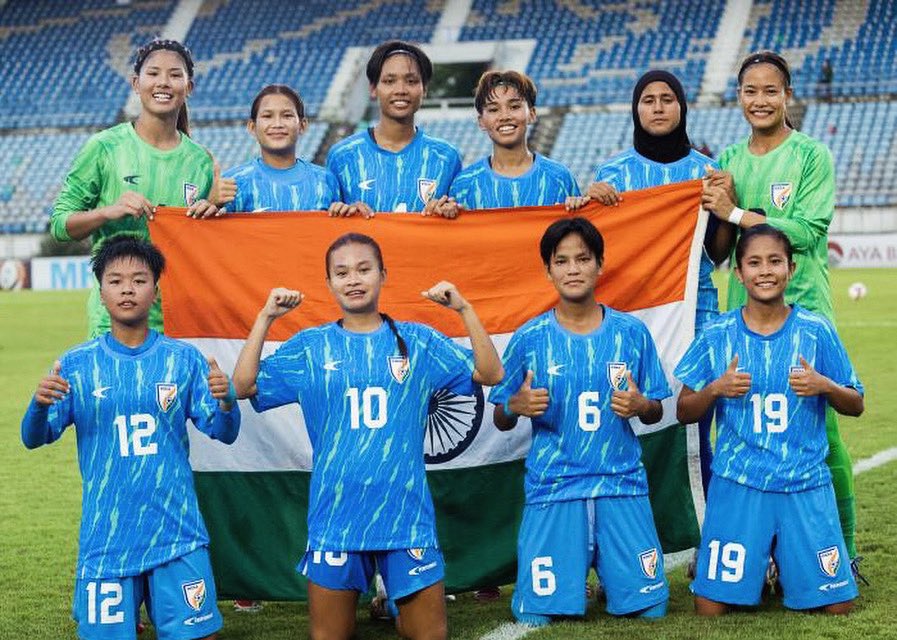
The 2025 campaign will go down as the turning point for Indian women’s football. The U20 team didn’t just qualify; they redefined what sustained preparation, mental resilience, and long-term planning can achieve. From the 135-day camp in Bhubaneswar to the decisive night in Yangon, the journey validated a system that prioritizes continuity over crisis management.
As India prepares for Thailand 2026, the message is clear the future of women’s football in India isn’t waiting to be built. It’s already here, and it’s learning how to win.


