Sentinel of the Blue Tigresses: The Rise of Captain Sweety Devi in Indian Women’s Football

Sweety Devi
Spread the love

0
(0)

Indian women’s football has produced several leaders over the years, but few embody resilience and defensive authority quite like Ngangbam Sweety Devi.

The centre-back from Manipur has steadily risen through the ranks of Indian football to become the captain of the national team, symbolising both the progress and the persistent challenges faced by the women’s game in the country.

Born on December 1, 1999, in the Langthabal region of Imphal West, Manipur, Sweety Devi’s journey reflects the deep football culture of the northeastern state. Today, she stands as one of the most dependable defenders in the Indian setup and a central figure in the team’s ambitions at the continental level. 

Watch Indian Live Scores and Play Quiz – Download IndiaSportsHub App

Manipur has long been recognised as one of the strongest nurseries of football talent in India. The state’s influence is visible across national teams, particularly in women’s football. In the Indian squad for the 2026 AFC Women’s Asian Cup, several key players including goalkeeper Elangbam Panthoi Chanu and defender Shilky Devi Hemam hail from the same region.

The dominance of Manipuri football is also evident at the domestic level. The state team has won the Senior Women’s National Football Championship (Rajmata Jijabai Trophy) an astonishing 23 times in 29 editions, illustrating a robust ecosystem that consistently produces high-quality players. 

Sweety Devi emerged from this system, benefiting from a culture that encourages girls to pursue football seriously from a young age. Community support, strong local clubs, and a competitive grassroots environment helped shape her early development.

Learning the Game the Hard Way

A defining influence in Sweety’s career was her father, Ngangbam Ruhikanta Singh, who worked as a football coach. Under his guidance, she adopted an unconventional yet highly effective training method competing regularly against boys during her formative years.

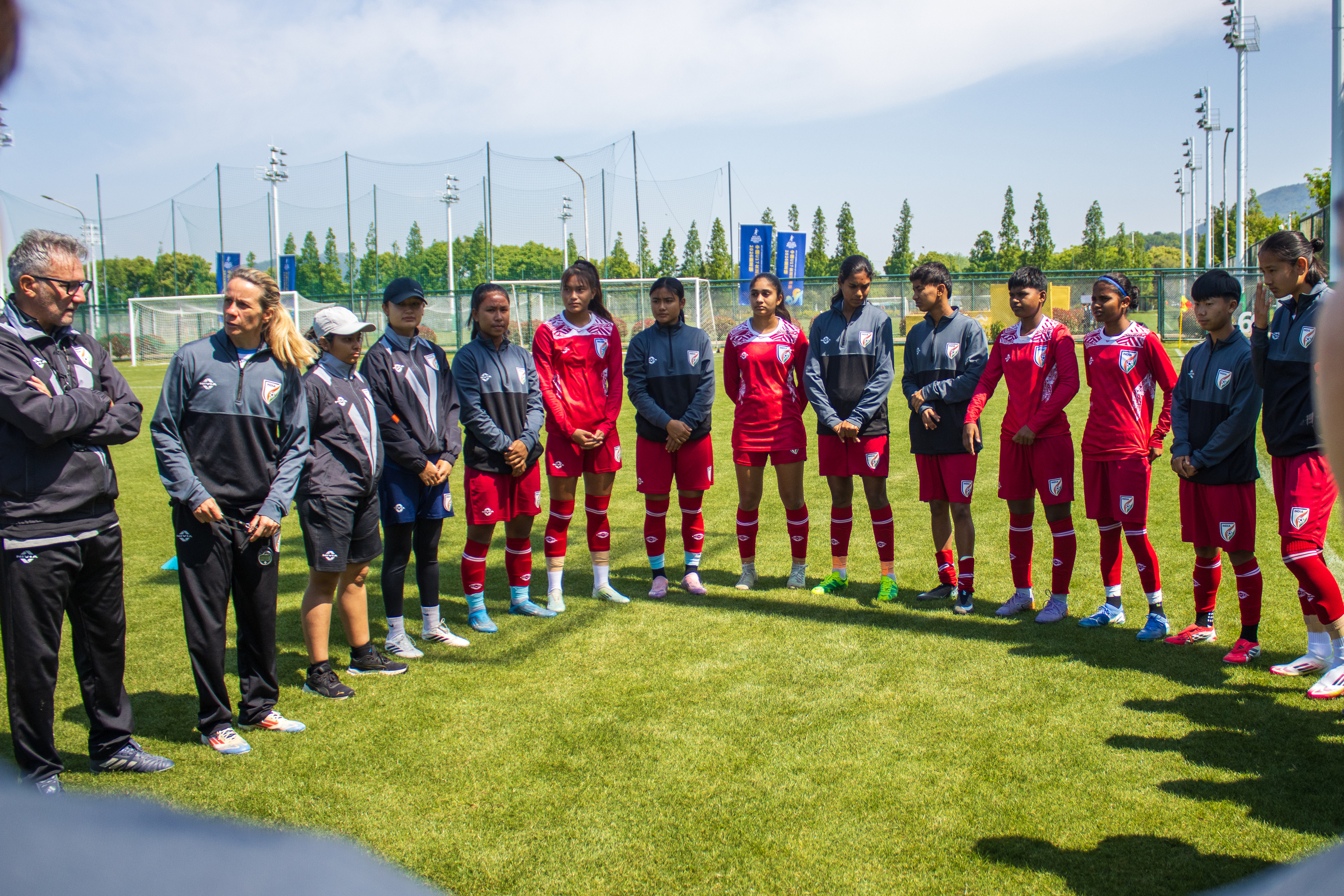
Sweety Devi
Credit Indian Football

This approach significantly sharpened her physical and tactical attributes. Facing stronger and faster opponents forced Sweety to improve her positioning, anticipation, and tackling precision. Even today, she credits this experience for her ability to handle high-pressure situations against top Asian attackers.

“I grew up tackling boys,” she has often said, explaining how those early experiences toughened her mentality and prepared her for international football. 

A Modern Ball-Playing Defender

At around 1.70 metres tall, Sweety combines physical strength with tactical intelligence. While her primary role is defensive solidity, she also possesses an increasingly valuable modern skill: the ability to initiate attacks from the back. Technical observers frequently describe her as a ball-playing centre-back, capable of launching accurate long passes that bypass midfield lines. These diagonals often release attacking players like Manisha Kalyan or Grace Dangmei, helping India transition quickly from defence to attack.

Her aerial strength, aggressive tackling, and positional awareness have made her one of the most reliable defenders in the Indian squad. Alongside veteran defender Ashalata Devi, Sweety forms the backbone of India’s defensive line. Their partnership built through years of playing together at both club and national levels provides tactical stability and leadership.

Growth Through Domestic Football

Sweety Devi’s rise also mirrors the gradual professionalisation of women’s football in India. Her domestic career began with Eastern Sporting Union, where she made her Indian Women’s League (IWL) debut during the 2017–18 season. Strong performances soon earned her a move to Sethu FC, where she played a crucial role in their 2018–19 IWL title victory. 

Subsequent stints with KRYPHSA FC, Kickstart Karnataka, and Odisha FC helped expand her experience across different tactical systems. Her most significant club move came in 2024, when she joined East Bengal FC, one of India’s most historic football clubs. Sweety was appointed captain of the team and led them to the 2024–25 IWL title, further cementing her reputation as a natural leader.

The club also participated in the AFC Women’s Champions League, giving Sweety exposure to higher-level international competition at the club stage.

Watch Indian Live Scores and Play Quiz – Download IndiaSportsHub App

Sweety Devi made her senior international debut in 2017 against South Korea during a period of transition for the Indian team. Over the next few years, she quickly established herself as a regular starter. Her early international success came with India’s dominance in South Asian competitions. She was part of the squad that won the 2019 SAFF Women’s Championship and the gold medal at the 2019 South Asian Games, helping reinforce India’s regional supremacy. 

In October 2021, she scored her first international goal in a friendly against the United Arab Emirates, marking another milestone in her international career. By the age of 26, Sweety had already accumulated over 60 international caps, underlining her consistency and importance to the national team.

Redemption After the 2022 Asian Cup Setback

One of the most difficult moments in the team’s recent history came during the 2022 AFC Women’s Asian Cup, which India hosted. The team was forced to withdraw from the tournament after a COVID-19 outbreak within the squad. For players like Sweety Devi, the episode was heartbreaking. However, it also became a turning point.

The team focused on rebuilding and qualifying for the next Asian Cup through the regular qualification route. Their efforts paid off when India topped their qualification group with victories over Mongolia, Timor-Leste, Iraq, and Thailand, securing a historic return to the continental championship on merit. 

Sweety’s leadership qualities earned her the captaincy of the national team during the 2026 AFC Women’s Asian Cup campaign.

Despite being one of the younger leaders in the squad, she has embraced the responsibility with humility.

“It’s always a proud moment to be captain,” she said after qualification. “But this is about the whole team. The armband only represents the responsibility the team has given me.”

Her calm leadership style emphasises collective effort rather than individual recognition.

Sweety Devi’s story also carries wider social significance. Coming from a modest background in Manipur, she has become a role model for aspiring footballers across India especially young girls who face societal barriers in pursuing sports careers. Her success illustrates how grassroots systems, community support, and perseverance can produce international-level athletes even in resource-constrained environments.

The ultimate dream for Sweety Devi and the current generation of Indian players is qualification for the 2027 FIFA Women’s World Cup. The Asian Cup serves as the primary pathway, with the top teams earning direct qualification to the global tournament.

For India, reaching that stage would represent the biggest milestone in the history of women’s football in the country. At the centre of that dream stands Sweety Devi the sentinel of India’s defence and the leader of a team determined to reclaim its place among Asia’s elite.

How useful was this post?

Click on a star to rate it!

Average rating 0 / 5. Vote count: 0

No votes so far! Be the first to rate this post.


Spread the love

Leave a Reply

IndiaSportsHub
Privacy Overview

This website uses cookies so that we can provide you with the best user experience possible. Cookie information is stored in your browser and performs functions such as recognising you when you return to our website and helping our team to understand which sections of the website you find most interesting and useful.