
Rishabh Das Breaks National Record in 200m Backstroke at NSW State Open

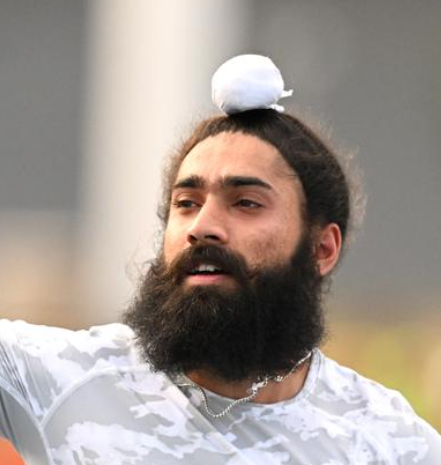
Rishabh Das
Spread the love

0
(0)

Indian swimmer Rishabh Das delivered another landmark performance for Indian aquatics, breaking the national record in the men’s 200m backstroke while winning a bronze medal at the New South Wales (NSW) State Open Swimming Championships in Sydney.

The Asian Aquatics Championships medallist clocked 2:00.14, surpassing his own previous national mark of 2:00.65, which he had set at the Senior National Championships in 2025.  The performance represents a significant step forward in the career of the young backstroke specialist and further strengthens his position as one of India’s leading swimmers heading into the upcoming international cycle.

Watch Indian Live Scores and Play Quiz – Download IndiaSportsHub App

Competing at the Sydney Olympic Park Aquatic Centre, Das produced a strong performance against a competitive international field. His time of 2:00.14 earned him third place in the final, finishing behind Australia’s Stuart Swinburn and Henry Allan. The improvement of 0.51 seconds over his previous national record is considerable in a 200-metre race, particularly at this stage of the season when athletes are still building towards peak form. 

Breaking the national record for the second time within a year highlights the steady progress Das has made since emerging as India’s leading backstroke swimmer. His new mark also pushes him closer to the highly coveted sub-two-minute barrier, a milestone that remains one of the key targets for elite swimmers in the event.

Rishabh Das
Credit IIS

The NSW State Open is regarded as a high-level domestic competition in Australia and regularly features several national and international swimmers. For Das, racing in such a field provided valuable competitive exposure while testing his mid-season conditioning.

Watch Indian Live Scores and Play Quiz – Download IndiaSportsHub App

Beyond his national record swim in the 200m backstroke, Das also impressed in the shorter backstroke events during the meet. In the 50m backstroke, he claimed another bronze medal while setting a new personal best of 25.83 seconds in the final. The improvement was the culmination of a remarkable progression across the day.

Das first lowered his previous personal best of 25.98 seconds during the morning heats with a time of 25.96 seconds. He then improved further in the evening final, delivering a powerful performance to clock 25.83 seconds and secure his second podium finish of the meet. The rapid improvements between the heats and the final demonstrated his strong race management and ability to refine technique within a short time frame.

In the 100m backstroke, Das also displayed consistency by equaling his personal best of 55.74 seconds during the preliminary round. That performance placed him ninth overall, narrowly missing a spot in the final but underlining his growing competitiveness across all three backstroke distances.

Signs of a Technical Evolution

The record-breaking swim in Sydney reflects a broader evolution in Das’s race strategy and physical conditioning.

In earlier seasons, his 200m backstroke races were typically structured around a conservative start followed by a strong finishing burst. However, recent performances indicate a shift towards a more aggressive pacing strategy, maintaining higher speed throughout the race rather than relying solely on late acceleration.

This change has likely been influenced by exposure to elite training environments and stronger international competition. Maintaining speed consistently over four lengths of the pool requires a delicate balance between aerobic endurance and anaerobic power. The improvement in Das’s time suggests he has made significant gains in both areas.

Another key factor in modern backstroke racing is the underwater phase after turns, often referred to as the “fifth stroke” in competitive swimming. Faster underwater dolphin kicks and sharper turns can significantly reduce race times, and such technical refinements are widely believed to have contributed to Das’s new national record.

Das’s achievements in Sydney build on a strong run of performances over the past year. He previously earned a bronze medal in the 200m backstroke at the Asian Aquatics Championships, confirming his ability to compete against some of the continent’s strongest swimmers. Those results marked an important step in his transition from a domestic champion to a swimmer capable of delivering results at the international level.

The latest record reinforces that trajectory and places him firmly among the country’s most promising athletes in the pool. Rishabh Das’s rise also highlights the growing depth of India’s high-performance swimming ecosystem.

His early development was shaped by structured training programmes and long-term coaching support, which helped nurture his technical abilities from a young age. Over time, exposure to international competition and training camps has further refined his racing skills.

Increasing collaboration between domestic academies, international training systems, and sports institutes has begun to create pathways for Indian swimmers to train and compete at a higher level.

Such systems are crucial in a sport like swimming, where consistent access to world-class facilities and competition is essential for progress. While the national record is a significant achievement, Das will now be aiming for further improvements as he targets upcoming major events.

Breaking the two-minute barrier in the 200m backstroke remains a major milestone and could place him among the stronger performers at continental competitions. Achieving that level would also strengthen India’s chances in international championships where backstroke events have traditionally been dominated by swimmers from East Asia, Australia, and Europe.

His performances across the 50m, 100m, and 200m backstroke events at the NSW State Open suggest he is developing into a versatile competitor capable of delivering strong results in multiple distances. Rishabh Das’s record-breaking swim in Sydney represents more than an individual milestone. It reflects the gradual progress of Indian swimming as athletes gain greater access to high-performance training environments and international competition.

By lowering his own national record and collecting two bronze medals in a competitive international field, Das has underlined his status as one of the country’s leading swimmers.

If his upward trajectory continues, the young backstroker could play a crucial role in shaping India’s ambitions in the pool over the coming years.

How useful was this post?

Click on a star to rate it!

Average rating 0 / 5. Vote count: 0

No votes so far! Be the first to rate this post.


Spread the love

Leave a Reply

IndiaSportsHub
Privacy Overview

This website uses cookies so that we can provide you with the best user experience possible. Cookie information is stored in your browser and performs functions such as recognising you when you return to our website and helping our team to understand which sections of the website you find most interesting and useful.