Manasi Joshi: Engineering Excellence On Court, Equality Beyond It
When Manasi Joshi won bronze at the 2026 BWF Para Badminton World Championships in Bahrain, it was not just another medal in an already decorated career. It was her eighth World Championship medal and perhaps one of the most significant. Because what it represents is rare in elite sport, sustained relevance.
From 2015 to 2026, across six different editions of the World Championships, Joshi has stood on the podium every single time. In an era where para-badminton has become faster, more competitive, and technologically demanding, maintaining that level across more than a decade is not just about talent. It is about adaptation, precision, and evolution.
At 36, Joshi is no longer just competing. She is building performance, policy, and pathways.
Watch Indian Live Scores and Play Quiz – Download IndiaSportsHub App
Born in Rajkot and raised in Mumbai, Joshi’s life did not initially point toward professional sport. She studied electronics engineering and worked as a software engineer at Atos India. Badminton was something she played growing up introduced to multiple sports by her family, eventually gravitating toward the racket.

Everything changed in 2011.
A road accident led to an above-knee amputation of her left leg. Rehabilitation began not with medal dreams but with a simple objective: regain movement. Badminton re-entered her life first as therapy, then as discipline, and eventually as purpose.
“I gave myself two to three years,” she has said in the past. “I wanted to stay fit and not lose hope.”
What began as a hobby became a high-performance pursuit. Her international debut came in 2015. Within four years, she was World Champion.
The 2019 Gold: A Tactical Masterclass
If there is one match that defines Manasi Joshi’s competitive identity, it is the 2019 BWF Para Badminton World Championship final.

She trailed 2–7 in the opening game against Parul Parmar a seasoned opponent she had lost to three times that year. Finals are rarely about physical superiority; they are about emotional control. Joshi re calibrated mid-match. Rather than chase points, she focused on reading the court. Her drives became sharper. Her smashes found angles. The drop shots began dictating tempo. She won 21-12, 21-7.
“Once you know what doesn’t need to be done, you eventually know what needs to be done,” she once reflected about that match.
That ability to diagnose, adapt, and execute is perhaps where her engineering mind reveals itself most clearly.
Understanding SL3: Half Court, Full Strategy
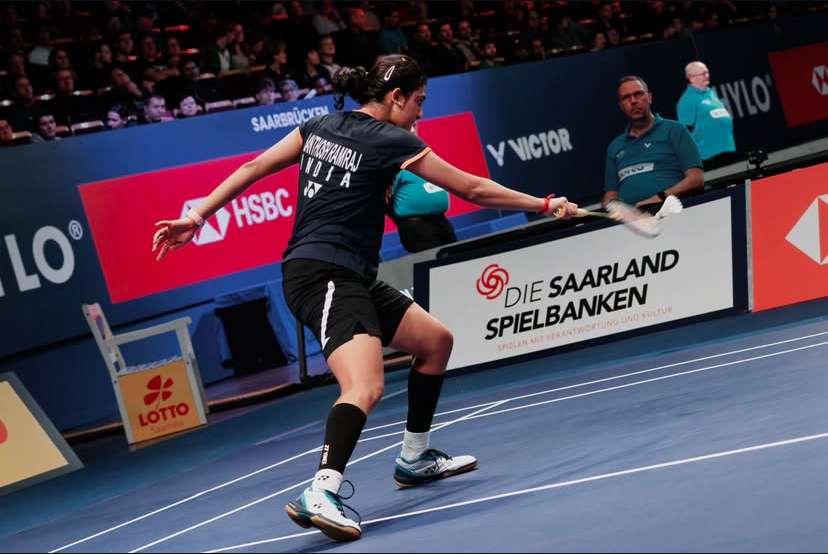
Joshi competes in the SL3 classification designated for athletes with lower-limb impairment affecting balance and movement. Singles matches are played on a half-width court. To the untrained eye, it may seem easier. It is not.
With less lateral space, rallies become more compact. Shot placement must be surgical. Court awareness is everything. There is no margin for imprecision because recovery speed is limited. In SL3, constructing a rally is closer to solving a geometric problem than overpowering an opponent.
Joshi’s height, net control, and deceptive drops have allowed her to dominate tactically. But sustaining that dominance over 10+ years has required something more complex: prosthetic evolution.

Elite para-badminton today is as much about equipment as it is about skill. A standard walking prosthetic is not built for lateral acceleration, deceleration, and rotational torque. Sports-specific blades are expensive, require custom fitting, and need periodic replacement.
Joshi currently uses separate prosthetic for daily mobility, training, and competition. High-end microprocessor prosthetic can cost upwards of ₹20–25 lakh, often without insurance support. This technological demand creates competitive disparity. Not every athlete can afford optimised equipment.
Joshi has spoken openly about this inequity not from a place of complaint, but from structural awareness. At the SL3 level, where global parity has increased significantly, marginal technological advantages can determine podium finishes.
And yet, she continues to medal.
Bronze in 2026: Longevity as Legacy
Her recent bronze in Bahrain marks medals at every World Championship edition since 2015, 2015, 2017, 2019, 2022, 2024, 2026.
Multi-cycle retention in para-sport is rare. Younger athletes enter with improved conditioning, faster footwork adaptations, and better access to international exposure. For Joshi, staying competitive has meant rethinking recovery cycles, recalibrating training intensity, and adjusting strategy against newer playing styles.

This phase of her career is less about breakthrough victories and more about refinement. She is not chasing a narrative of reinvention. She is pursuing excellence through continuity.
Watch Indian Live Scores and Play Quiz – Download IndiaSportsHub App
Manasi Joshi’s impact, however, cannot be measured by medals alone. She is a petitioner in a constitutional case challenging the Goods and Services Tax (GST) on assistive devices such as prosthetic limbs. She has described it as a “tax on walking.”
The argument is straightforward: essential mobility aids should not be taxed like consumer goods. For Joshi, this is not abstract activism. It is lived reality. Access to prosthetic technology directly influences mobility, independence, and athletic competitiveness.
Her advocacy signals a shift in how para-athletes position themselves not as recipients of charity, but as citizens demanding rights.
Redefining Media Narratives
Joshi has also consistently challenged how para-sport is framed. Too often, athletes with disabilities are portrayed through lenses of sympathy or exaggerated inspiration. Joshi’s career disrupts that simplification. She is an elite competitor operating in a high-performance system.
She became the first para-athlete globally to feature on the cover of TIME Magazine Asia as a Next Generation Leader in 2020. Recognition followed from the BBC 100 Women list and the Arjuna Award. But her message remains consistent: sport must be treated as a profession, not philanthropy.
India’s para-sport landscape has evolved. Events like the Khelo India Para Games have widened participation. State federations are increasingly structured. Corporate sponsorship, such as backing from the Welspun Group, has enabled consistent global competition. She mentioned that she is very grateful to the corporate sponsorship she has received.
Yet, district-level accessibility gaps remain from infrastructure design to equipment funding to classification awareness. Joshi has often emphasised that talent exists everywhere. Pathways do not.
Her own journey from corporate professional to world champion was possible because she accessed elite training ecosystems like the Pullela Gopichand Academy, where para-athletes trained within mainstream high-performance environments.
Integration, she believes, is key.

At this stage, Joshi’s career sits at a unique intersection: performance longevity, technological adaptation, policy advocacy, and ecosystem-building. She is still competing. Still medalling. Still refining her game.
But she is also engineering a broader future one where para-athletes do not need to justify their presence, where assistive devices are affordable, where infrastructure is accessible by design, not retrofitted as an afterthought.
When asked what she would tell young athletes, her message remains simple:
“Don’t focus on results. Focus on the process. And don’t let anything define what you are allowed to do.”
Manasi Joshi’s story is not about overcoming adversity. It is about system design on court and off it. And she is still building.
How useful was this post?
Click on a star to rate it!
Average rating 0 / 5. Vote count: 0
No votes so far! Be the first to rate this post.