
India Set to Field Full-Strength Men’s and Women’s Squads for Cricket at Asian Games 2026 in Japan

Asia Cup
Spread the love

0
(0)

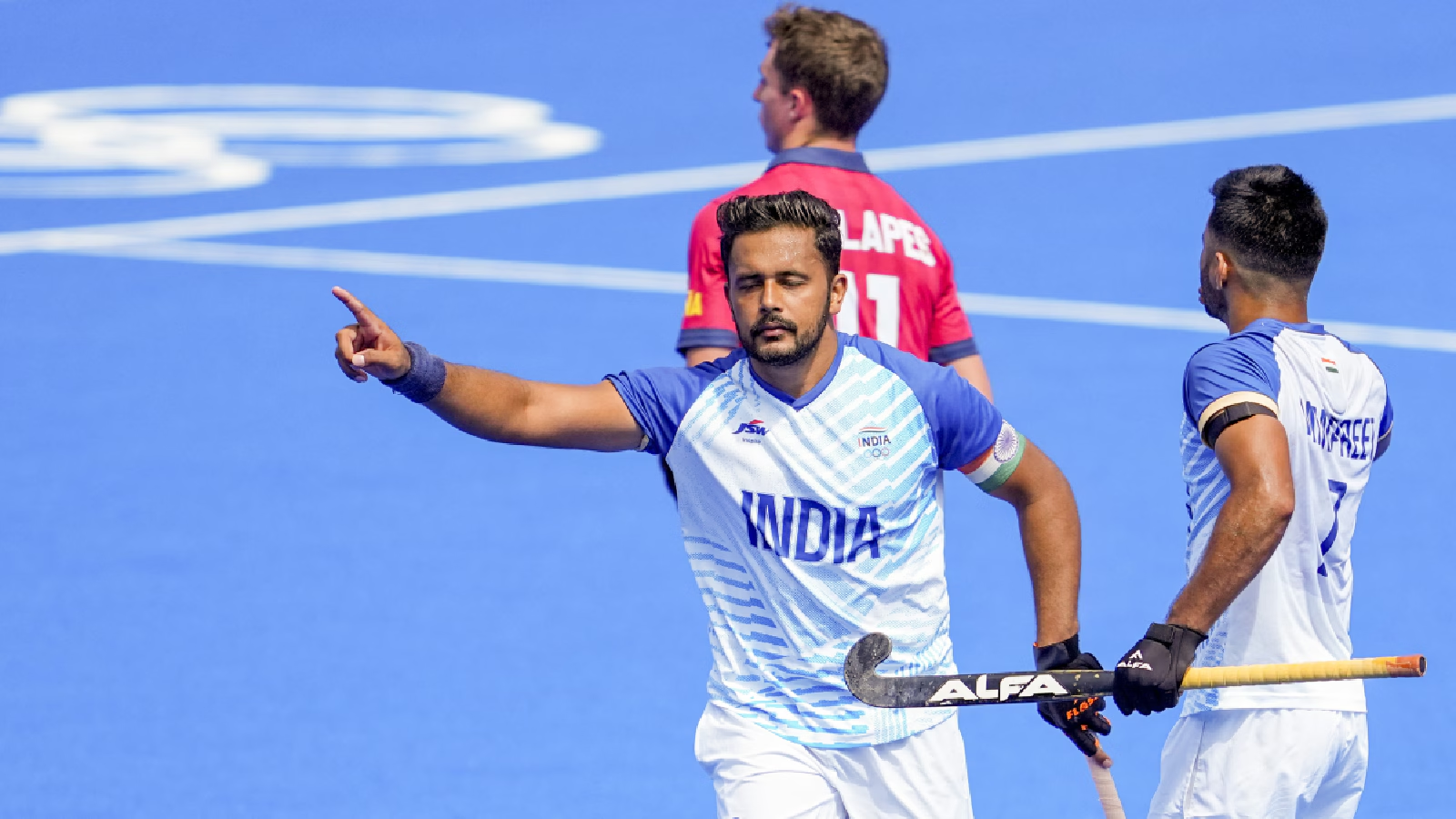
India is set to take a decisive step in aligning its cricketing ambitions with the broader Olympic movement, with the country preparing to field its top men’s and women’s cricketers for the T20 competition at the Asian Games 2026 in Aichi–Nagoya, Japan.

Scheduled between September 19 and October 4, 2026, with cricket events beginning from September 17, the upcoming Asian Games is expected to mark a significant strategic shift in how Indian cricket approaches multi-sport events. Historically, participation at the Asian Games has often been managed with developmental or fringe squads due to scheduling conflicts with ICC tournaments or bilateral commitments. However, the approach for 2026 appears markedly different, reflecting long-term planning tied to cricket’s inclusion in the Los Angeles 2028 Olympic Games.  

At the centre of this evolving strategy is the decision by the Board of Control for Cricket in India (BCCI) to forward a long list of its premier players to the Indian Olympic Association (IOA), signalling its intent to deploy competitive squads in both the men’s and women’s events. The final squads are expected to be confirmed by May 2026, with selection parameters shaped not just by form and fitness but also by the Ministry of Youth Affairs and Sports’ revised guidelines for the Asian Games contingent.  

Under these updated guidelines, only athletes and teams ranked among the top eight in Asia in team sports or top six in individual disciplines will be eligible for participation, reinforcing a results-oriented selection framework. This effectively necessitates the inclusion of India’s strongest available T20 personnel in order to justify government-backed logistical and financial support.

Asian Games 2026
Credit ICC Cricket WC

From a scheduling standpoint, the Asian Games slot in 2026 presents a rare opportunity. Unlike previous editions, where marquee Indian players were occupied with World Cups or bilateral tours, the Games window this time is relatively free of major international assignments. This allows India to realistically contemplate sending a near full-strength contingent in pursuit of continental gold.

For the men’s team, the proposed core is expected to include several of India’s frontline T20 specialists—players who have formed the backbone of recent ICC tournament campaigns. Emerging attacking options such as Abhishek Sharma, whose aggressive powerplay batting has elevated India’s top-order intent in white-ball cricket, are likely to be central to the tactical blueprint. Similarly, the resurgence of mystery spinner Varun Chakaravarthy, who has enjoyed a prolific wicket-taking run in the lead-up to 2026, could prove crucial in unfamiliar conditions expected in Japan.

Watch Indian Live Scores and Play Quiz – Download IndiaSportsHub App

Leadership, too, is undergoing transition. With senior stalwarts Rohit Sharma and Virat Kohli stepping away from the T20I format to focus on ODI cricket in the lead-up to the 2027 World Cup, the Asian Games squad is expected to showcase the next generation of Indian white-ball leadership. This shift aligns with the broader evolution of India’s central contract system, which has already seen a restructuring aimed at rewarding multi-format contributors over legacy seniority.

On the women’s side, India enters the Games as the dominant force in Asian cricket following their historic ODI World Cup triumph in 2025. Led by Harmanpreet Kaur who recently became the most capped player in women’s international cricket the team combines tactical experience with a pipeline of emerging domestic talent nurtured through the Women’s Premier League and the domestic circuit.  

The inclusion of domestic standouts such as Kranti Gaud and Sree Charani in preliminary discussions reflects a deliberate attempt to blend established international performers with players who have excelled in the national ecosystem. For the women’s team, the Asian Games will serve as a key preparatory phase in the run-up to future global assignments, including the ICC Women’s T20 World Cup and Olympic qualification cycles.

The choice of Nagoya as the host city introduces a set of unique technical challenges. Unlike traditional cricketing nations, Japan lacks purpose-built international stadiums for the sport. To address this, organisers are repurposing an existing baseball facility at Korogi Athletic Park in Nisshin City, where a central cricket square will be installed across three adjoining fields an innovative solution designed to meet ICC surface standards while maximising available infrastructure.

Watch Indian Live Scores and Play Quiz – Download IndiaSportsHub App

This unconventional venue configuration could influence team selection, particularly favouring spin-heavy attacks and adaptable batting units capable of negotiating slower surfaces and potentially irregular outfield dimensions. Morning match timings likely to begin as early as 05:30 IST also raise the possibility of dew-related tactical adjustments.

The Asian Games cricket competition itself will feature a high-density T20 format, with daily double-headers planned to accommodate a 10-team men’s draw and an eight-team women’s tournament. While lower-seeded nations will compete in preliminary rounds, traditional powerhouses such as India, Pakistan, Sri Lanka, Afghanistan and Bangladesh are expected to enter directly at the knockout stage.

Beyond immediate medal aspirations, the 2026 Asian Games represent a broader institutional pivot. Participation in a multi-sport environment underscores India’s intent to integrate cricket within the Olympic sporting framework bridging the long-standing divide between bilateral cricket and the multidisciplinary ethos of global events.

Watch Indian Live Scores and Play Quiz – Download IndiaSportsHub App

In many ways, Nagoya serves as a rehearsal stage for Los Angeles. The operational challenges, scheduling pressures, and tactical nuances encountered in Japan will inform India’s roadmap toward Olympic cricket in 2028. For a nation that has historically dominated the sport in standalone formats, the Asian Games now offer an opportunity to extend that supremacy within the wider Olympic movement.

With both men’s and women’s teams likely to arrive in Japan as defending champions from Hangzhou 2023, expectations will be high. For Indian cricket, however, the stakes extend beyond continental success the 2026 Asian Games are a defining checkpoint in the journey toward Olympic recognition and sustained global relevance.

How useful was this post?

Click on a star to rate it!

Average rating 0 / 5. Vote count: 0

No votes so far! Be the first to rate this post.


Spread the love

Leave a Reply

IndiaSportsHub
Privacy Overview

This website uses cookies so that we can provide you with the best user experience possible. Cookie information is stored in your browser and performs functions such as recognising you when you return to our website and helping our team to understand which sections of the website you find most interesting and useful.